Friday, August 29, 2025

Canon 400MP CIS

Link: https://www.photografix-magazin.de/canon-zeigt-410-mp-vollformatsensor-technik-rekord-fuer-spezialanwendungen/

Related post on the blog in January: https://image-sensors-world.blogspot.com/2025/01/canon-announces-410mp-full-frame-sensor.html 

Canon has presented its new record image sensor with 410 megapixels to the public for the first time. The presentation took place at the P&I 2025 in China.

Spectacular engineering key data 

  •  Resolution: 24.592 x 16,704 pixels, which corresponds to almost 200 times Full-HD and 12 x 8K.
  •  Sensor architecture : New, rearly lit stacked sensor with integrated signal processing.
  •  Data throughput : impressive read speed of 3,280 MP/s, which allows 8 frames/s in full resolution.
  •  Monochrome version : Uses 4-pixel binning for higher light sensitivity and allows 100 MP videos at 24 fps.

Target market: Industry instead of consumers

Canon does not position the LI8030SA for the mass market, but for highly specialized industries such as monitoring, medicine and machine vision. At P&I 2025, the sensor was presented behind glass, which is usually a clear signal that it is still in the development phase. Canon is already looking for expressions of interest, but the first models should not be intended for classic cameras. Nevertheless, the technology could also influence commercial Canon sensors in the future.

With the 410-MP sensor, Canon impressively shows where the journey can go. For hobby photographers, however, this sensor remains a distant dream. Most of us don't need such an exaggerated resolution anyway. In the professional sector, however, it opens up new dimensions.

Wednesday, August 27, 2025

Harvest Imaging 2025 Forum - Dec 8, 9 - Single-Photon Detection

Registration page: https://harvestimaging.com/forum_introduction_2025_coming.php

The Harvest Imaging forum will continue with a next edition scheduled for December 8 & 9, 2025, in Delft, the Netherlands. The basic intention of the Harvest Imaging forum is to have a scientific and technical in-depth discussion on one particular topic that is of great importance and value to the digital imaging community.

The 2025 Harvest Imaging forum will deal with a single topic and will have only one world-level expert as the speaker: 

"SINGLE PHOTON DETECTION"
Prof. dr. Robert HENDERSON (Univ. of Edinburgh, UK)

Abstract:

Access to the ultrafast quantum statistics of light enabled by new solid-state single photon imaging technologies is revolutionizing camera technology. 

The noise-free detection and precise localization of individual photons enables imaging of time itself (which directly enables depth perception) at unprecedented temporal and spatial resolutions. Such solid-state single photon imaging technologies now approach the sensitivity, timing resolution and dark noise of vacuum electrocathode approaches whilst providing robustness, low cost and high spatial resolution. Amongst these, CMOS single Photon Avalanche Diode (SPAD) arrays offer the unique capability to extract single photon statistics in high background conditions using massively parallel on-chip timing and digital computation.

This forum will highlight the modelling, device structures, characterisation methods and circuitry necessary to develop this new generation of SPAD imaging system. Recent advances in SPAD direct time of flight (dToF) and photon counting sensor design techniques optimized for low power, computation, and area will be reviewed. 

The forum will focus primarily on the mainstream commercial applications of SPADs in low light imaging, depth imaging (RGB-Z) and LIDAR. Further examples will be drawn from emerging use cases in fluorescence microscopy, Raman spectroscopy, non-line-of-sight imaging, quantum optics and medical diagnostics (X-ray, PET). Future trends and prospects enabled by 3D-stacking technology will be considered.

Bio

Robert K. Henderson is a Professor of Electronic Imaging in the School of Engineering at the University of Edinburgh. He obtained his PhD in 1990 from the University of Glasgow. From 1991, he was a research engineer at the Swiss Centre for Microelectronics, Neuchatel, Switzerland. In 1996, he was appointed senior VLSI engineer at VLSI Vision Ltd, Edinburgh, UK where he worked on the world’s first single chip video camera.

From 2000, as principal VLSI engineer in STMicroelectronics Imaging Division he developed image sensors for mobile phone applications. He joined University of Edinburgh in 2005, designing the first SPAD image sensors in nanometer CMOS technologies in the MegaFrame and SPADnet EU projects. This research activity led to the first volume SPAD time-of-flight products in 2013 in the form of STMicroelectronics FlightSense series, which perform an autofocus-assist now present in over 2 billion smartphones. He benefits from a long-term research partnership with STMicroelectronics in which he explores medical, scientific and high speed imaging applications of SPAD technology. In 2014, he was awarded a prestigious ERC advanced fellowship. He is an advisor to Ouster Automotive and a Fellow of the IEEE and the Royal Society of Edinburgh.

Monday, August 25, 2025

Sony 3-layer stacked sensor

Tranlated from baidu.com: https://baijiahao-baidu-com.translate.goog/s?id=1839758590887948034&wfr=spider&for=pc&_x_tr_sl=zh-CN&_x_tr_tl=de&_x_tr_hl=de&_x_tr_pto=wapp

In-depth: Sony's three-layer CIS changes the global sensor market

Source: AI Core World (Aug 7, 2025)

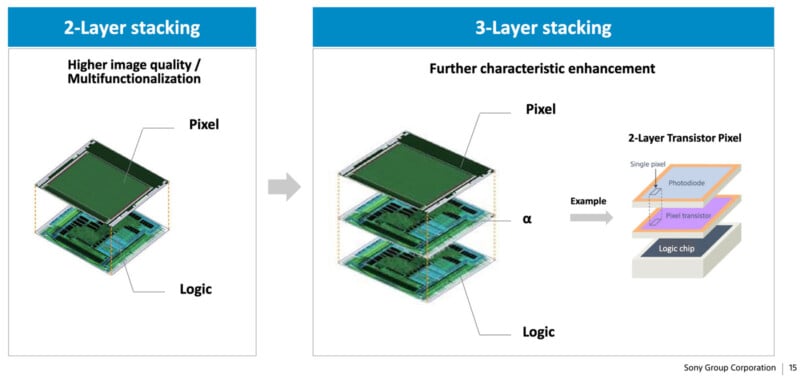
Sony is developing a three-layer image sensor

Sony Semiconductor Solutions (SSS) showcased a potentially groundbreaking three-layer image sensor design as part of a presentation to investors, the company's Imaging & Sensing Solutions (I&SS) division announced today. The design promises significant performance improvements.

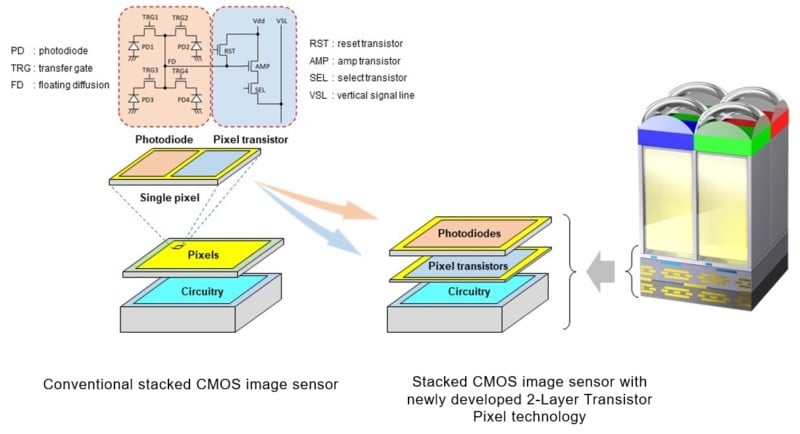
Although Sony has used stacked sensors in several cameras, including its flagship a1 II, these sensors currently have a dual-layer structure. One layer is the photodiode layer responsible for capturing light, which contains all the light-sensitive pixels; the other layer is the transistor layer located below it, which is responsible for image processing tasks. Sony's core long-term goal is to introduce the crucial third layer in the image sensor stack. This essentially means an expansion of processing power and a leap in image quality.

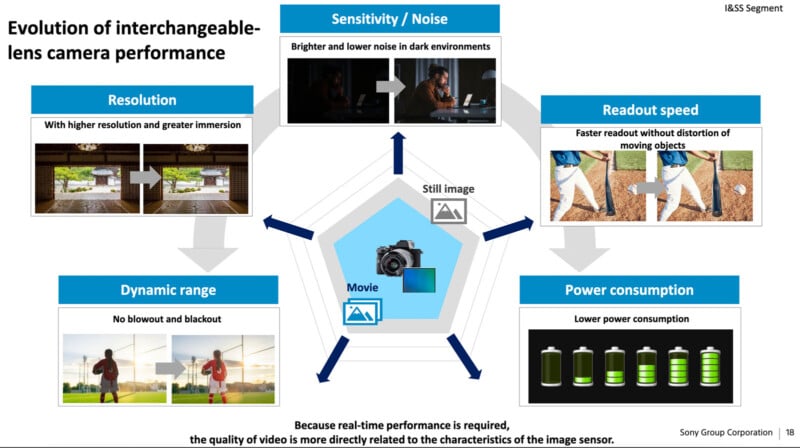
When other conditions are equal, the stronger the processing power at the sensor level, the better the imaging effect will naturally be. Sony explains that increasing processing power at the sensor level will directly translate into improvements in several key performance areas: dynamic range, sensitivity, noise performance, power efficiency, readout speed, and resolution.

While adding sensor layers doesn't directly change the pixel resolution itself, it unlocks entirely new video recording modes by significantly improving the overall speed and performance of the sensor.
Image sensors remain a core pillar of Sony's strategy in diverse areas including mobile devices, automotive, industrial and cameras. Sony expects the camera-related sensor market to continue expanding at a compound annual growth rate of 9% by fiscal 2030, which indicates that Sony will continue to increase its investment in this field. 

Next-generation sensor technology will become a driving force for differentiation

Sony is focusing on R&D in multi-layer sensor stack architectures and advanced process nodes to improve sensitivity, dynamic range, power efficiency and readout speed – cutting-edge technologies that will directly power future Alpha and FX camera series. To achieve these goals, Sony plans to invest a total of nearly 930 billion yen in capital expenditures between 2024 and 2026, about half of which will be dedicated to the research and development and production of advanced image sensor processes.
As outlined in its long-term strategy, Sony is going all out and investing in next-generation sensor technologies, including multi-layer stacked image sensors.

Sony's triple-stacked sensor, used in the Xperia 1 V and adopted by other mainstream smartphone models, significantly improves image quality. The architecture also supports multimodal sensing and on-chip artificial intelligence processing, marking a shift in the industry's focus from simply pursuing resolution to intelligent sensing. The breakthrough in 22nm logic stacking technology is committed to achieving ultra-low power consumption and expanded computing power, among which FDSOI technology is expected to be applied in the field of neuromorphic sensing.

---------------------------------------------- 

Also covered by PetaPixel: https://petapixel.com/2025/07/30/sonys-triple-layer-image-sensor-promises-huge-performance-gains/ 

 Sony’s Triple-Layer Image Sensor Promises Huge Performance Gains


Friday, August 22, 2025

AIStorm and Tower Semiconductor release AI-in-Imager chip

AIStorm & Tower Semiconductor Introduce Cheetah HS, World’s First Up-to-260K FPS AI-in-Imager Chip for Inspection, Robotics & Sports

Charge-domain imager with on-chip neural network, provides breakthrough slow-motion vision at a fraction of the cost and power consumption of competing high-speed cameras

HOUSTON, Texas, and MIGDAL HAEMEK, Israel - August 12, 2025: AIStorm, the market leader in charge-domain solutions for edge AI, and Tower Semiconductor (NASDAQ/TASE: TSEM), a leading foundry of high-value analog semiconductor solutions, today announced the availability of the Cheetah HS — a high-speed, 120×80-pixel imager with first-layer AI capability that captures up to 260,000 frames per second — 2,000 to 4,000 times faster than conventional CMOS sensors. The Cheetah HS architecture is made possible by Tower’s unique charge-domain imaging platform which is leveraged by AIStorm’s proprietary charge-domain-based analog AI neurons.

By combining ultra-high-speed imaging with charge-domain AI, Cheetah HS slashes system power requirements and bill-of-materials cost for designers of robotics, drones, vibration- and structure-health monitors, high-speed security and surveillance tracking systems, manufacturing and assembly lines, barcode readers, PCB-inspection equipment, biometric unlock systems, vehicle-speed detectors, and even golf-swing analyzers.

“Many consumer and industrial applications require ultra-slow-motion analysis of real-time events to analyze performance or detect anomalies. Such solutions are very costly, and our Cheetah HS solution makes them affordable for a wide range of markets and end applications,” said David Schie, CEO of AIStorm. “Tower is a global leader in charge-domain global-shutter pixels, making them the ideal partner for the development and production of such groundbreaking products.”
“We are very pleased to see the fruits of our long term, close collaboration with AIStorm on this unique breakthrough platform of analog charge-domain embedded AI technology,” said Dr. Avi Strum, SVP and GM of the Sensors and Displays BU at Tower Semiconductor. “Its inherent low-power, low-cost, and high-performance virtues will enable a family of affordable, high-volume products in the near future.”

Key advantages of Cheetah HS
 Adjustable frame rate up to 260,000 frames per second (fps)
 Integrated LED driver (programmable up to 40 mA)
 Enhanced low light performance
 Integrated charge-domain neuron layer outputting pulse streams for downstream neural-network layers or raw high-speed video
 Dramatic cost advantage over competitors
 Lowers processing costs by capturing images quickly, leaving more time per frame for processing
 Ability to capture extremely high-speed events and analyze them in slow motion

How it works
Traditional high-speed cameras utilize expensive high-speed data converters to capture data, which separates the AI input layer from the pixels, increasing the BOM cost and necessitating high-speed connectors and interface components. Cheetah HS’s charge-domain architecture converts incoming photons to charge, computes the first neural-network layer in analog form, then outputs a pulse train that can be processed by downstream networks. The capture rate is programmable, allowing lower frame rates with faster capture times (reducing the cost of processing) or faster frame rates for accurate measurements or slow-motion analysis.

Availability
Cheetah HS is available now in both chip form as well as full reference-camera systems [aistorm.ai/cheetah]. 

Thursday, August 21, 2025

A New Image Sensor Company in China is Recruiting

Shanghai Primevision Technology Co., LTD

Recruiting for 11 positions (Link to list) including:
CIS image sensor test - Link
CIS image sensor pixel design - Link
CIS (Image Sensor) Sales - Link

Most positions in Shanghai, China
曹蕾 Cao Lei, Human Resources Director, can provide additional details - lei.cao@primevision.ai

Wednesday, August 20, 2025

Toshiba announces linear CCD sensor for document scanners

Toshiba Releases Lens-Reduction Type CCD Linear Image Sensor with Low Random Noise That Helps Improve Image Quality in Devices Such as A3 Multifunction Printers

KAWASAKI, Japan--(BUSINESS WIRE)--Toshiba Electronic Devices & Storage Corporation ("Toshiba") has launched a lens-reduction type CCD linear image sensor “TCD2728DG” for A3 multifunction printers. Shipments start today. The sensor has 7,500 image sensing elements (pixels) and supports A3 multifunction printers. It is also more effective at reducing random noise (NDσ) than Toshiba’s current TCD2726DG.

Business offices are seeing a growing need for high-speed, high-resolution copying and scanning of large volumes of different kinds of documents. This is particularly true for A3 multifunction printers, where improving image quality has become an important issue, and NDσ in the signal has to be suppressed to enhance image quality.

TCD2728DG has lower output amplifier gain than Toshiba’s current product, TCD2726DG, and reduces NDσ by approximately 40%. This improvement enhances image quality in multifunction printers. The new CCD linear sensor achieves a data rate of 100 MHz (50 MHz × 2 channels), enabling high-speed processing of large volumes of images. This makes it well-suited for line scan cameras used in inspection systems that require real-time decision-making.

Toshiba will continue to expand its product lineup to support scanning by multifunction printers and the sensing applications of inspection devices, and to meet growing demand for high-speed, high-resolution imaging and sensing technologies. 

Applications
 A3 multifunction printers (resolution of 600 dpi)
 7500-pixel line scan camera for various inspection systems (semiconductor inspection equipment, food sorting equipment, etc.)


Features
 Reduces random noise by approximately 40%
 High-speed CCD linear image sensor: Data rate =100MHz (Master clock frequency 50MHz × 2ch) (max)
 The built-in timing generator circuit and CCD driver help facilitate system development 


Monday, August 18, 2025

Omnivision Needs an Applications Engineer

 Omnivision

Senior Applications Engineer - Santa Clara, California, USA - Link

Image sensor sampling strategies [video]


Electronic Sampling for Temporal Imaging: Computational Optical Imaging Episode 66 

This episode considers global and rolling shutter strategies and other alternatives for sampling of video. The very simple simulation presented is available at https://github.com/arizonaCameraLab/c... The frame interpolation research referenced is described at https://jianghz.me/projects/superslomo/


00:00 - Event cameras
00:56 - Visual cortex
01:41 - Image sensors
03:00 - Data plane coding
03:55 - Rolling shutter
05:50 - Rolling shutter simulation
09:09 - Temporal interpolation
09:59 - Random temporal sampling
11:12 - Sample data 
11:52 - Sample packing
12:29 - Rolling shutter compesation
15:15 - Dynamic range

Friday, August 15, 2025

Thursday, August 14, 2025

ESSERC 2025 smart cars workshop

The Role of Cameras and Photonics for Smart Cars 

Full day workshop on Sep 8th, 2025 @ ESSERC 2025 TU Munich

https://www.esserc2025.org/w8

Organizers
Cedric Tubert (STMicroelectronics, FR)
Daniele Perenzoni (Sony, IT) 

This workshop explores cutting-edge developments in automotive vision systems, highlighting the integration of advanced cameras and photonic technologies. We present significant advancements in Automotive High Dynamic Range Imaging specifically designed for High Temperature conditions, addressing one of the industry's most challenging operational environments. The session showcases innovative wafer-scale micro-optics and meta-surfaces that are revolutionizing both imaging and illumination applications. Attendees will gain insights into the evolution of next generation CMOS image sensors for smart cars and for Driver and Occupancy Monitoring systems. The workshop also examines hardware accelerators enabling low-latency event-based vision processing, critical for real-time decision. Finally, we address the integration challenges in 'Photonics on the Road,' exploring practical hurdles and solutions for implementing these technologies in self-driving vehicles. These innovations collectively demonstrate the essential role of photonics and imaging systems in creating safer, more efficient autonomous transportation.

Program 

09:30 - 10:15
Automotive High Dynamic Range Imaging in High Temperature Conditions
Tomas Geurts (Omnivision, BE)
​The talk will cover High Dynamic Range (HDR) requirements in ADAS and In-Cabin automotive imaging applications. The importance and relevance of performance at high temperature will be explained. The talk will highlight fundamental limitations of low-light and HDR performance at elevated temperatures which is an important aspect in automotive imaging but often under-illuminated in publications.​

10:15 - 11:00
Past and Future of CMOS Image Sensors in Automotive Industry
Yorito Sakano (Sony Semiconductor Solutions, JP)
Business motivation is essential for the evolution of semiconductor devices. The larger the market, the faster the technology evolves. The first iPhone was born in 2007, and the back-illuminated image sensor, an epoch-making event for CMOS image sensors, was introduced in 2009. With technical breakthroughs and business motivations coming together almost simultaneously, CMOS image sensors have undergone a dramatic technological evolution over the past decade or so. Similarly, automotive CMOS image sensors have recently undergone a unique evolution in the competitive axis of high dynamic range (HDR), supported by business motivation such as the evolution of Advanced Driver-Assistance Systems (ADAS) and the efforts toward the practical application of Autonomous Driving (AD). Let me overview the recent evolution of automotive CMOS image sensors and discuss the direction of future evolution.
​​​
11:00 - 11:30
Coffee break

11:30 - 12:15
Wafer Scale Micro-optics and Meta-surfaces for Applications in Imaging and Illumination
Falk Eilenberger (Fraunhofer, DE)
Micro- and nanooptical systems game-changers in our ability to manipulate light. Nanooptical systems, frequently called meta-surfaces, allow to access all degrees of freedom of the optical fields, such as spectral properties, its polarization, and its phase next to its intensity, which is classically addressed in imaging systems. Nano- and microoptical systems allow to introduce massive parallelization in optical systems, breaking virtually any commonly known design rules both for imaging as well as for illumination systems. Harnessing these degrees of freedom is, however, a grand challenge in terms of design, engineering, and cost scaling. In the talk I shall highlight how wafer scale fabrication techniques can be utilized to overcome these issues, if the entire process chain from design to the final application can be tailored to the specific requirements of the optical task at hand. I shall do so by highlighting a variety of applications and projects, in which wafer scale nanooptics have played a crucial role, from optics for satellite missions all the way to illumination systems for mobility solutions.

12:15 - 13:00
CMOS Image Sensors for Driver and Occupancy Monitoring Solutions
Jerome Chossat and Pierre Malinge (STMicroelectronics, FR)
Automotive applications require high-performance and cost-effective sensors. Considering these constraints, we present a novel pixel architecture capable of both rolling and global shutter imaging. Utilizing a non-Bayer CFA pattern, it captures both RGB and near-infrared images. A specific ASIL pixel design ensures a comprehensive integrity check of the sensor. The latter is connected to a logic circuit through a 3D Cu-to-Cu hybrid bonding process, providing state-of-the-art on-chip data processing and interfacing. Such a sensor is ideally suited for driver monitoring systems while enabling the integration of advanced multimedia features. Indeed, on top of the pixel and readout quality requirements, CMOS mage sensors for Driver and Occupancy Monitoring solutions are bringing a lot of challenges on the digital side too. They may contain quite complex signal processing for properly dealing with various non-Bayer CFA and manage IR content, they must integrate automotive safety capabilities, must be efficiently protected against malicious attackers aimed at tampering their functionalities, and must prevent usage of counterfeit components. In addition, all this must be done under aggressive cost constraint and stringent power constraints but also be developed in conformance with road vehicles functional safety (ISO26262), and Road vehicles Cybersecurity engineering (ISO21434).

13:00 - 14:00
Lunch

14:00 - 14:45
Hardware Accelerators for Low-latency Event-based Vision
Charlotte Frenkel (TU Delft, NL)
From optical flow to high-speed particle counting, event-based cameras emerge as an enabler for low-latency vision applications. They capture temporal contrast changes as a stream of events, which are generated on a per-pixel basis and at a temporal resolution of a few microseconds. However, there is currently a lack of hardware support for event-based processing workloads that generate updated predictions within microseconds. This talk will cover emerging developments in this area, from dynamic graph neural networks to digital in-memory computing for spiking neural networks.
 
14:45 - 15:30
Photonics on the Road: Navigating the Integration Hurdles in Self-Driving Cars
Christoph Parl (Valeo, DE)
Valeo is at the forefront of the autonomous driving revolution, providing a comprehensive suite of sensors - cameras, RADARs, ultrasonics, microphones, and LiDARs - that enable self-driving capabilities. This keynote will explore how Valeo's technology is driving the transition from manual to fully autonomous vehicles. A key focus will be on vehicle integration: the art of seamlessly embedding these sensors into the vehicle's design. This requires balancing function-driven design, ensuring optimal sensor performance, with emotion-driven design, creating desirable and engaging vehicles. The presentation will highlight the diverse sensors required for autonomy, with a focus on LiDARs due to complexity. Crucially, we will examine the challenges and solutions surrounding sensor mounting positions. Optimal placement is vital, considering each sensor's needs, environmental factors, and cleaning requirements. Finally, we'll explore how solid-state technology can help vehicle integration to enable more compact and robust solutions for a large-scale rollout of self-driving functions. 

15:30 - 16:00 
Coffee break

16:00 - 16:45
Final discussion and closing​​​​ 

Monday, August 11, 2025

NovoViz announces a SPAD-based event camera


The NovoViz NV04ASC-HW Asynchronous photon-driven camera was developed for applications requiring high sensitivity and/or frame rate but with reduced output bandwidth.

The camera combines the benefits of a single-photon avalanche diode (SPAD) camera, namely the single-photon resolution and fast operating speeds, with the benefits of an event camera – low output data rates.

64 x 48 SPAD pixels
100M fps
10ns resolution
Event-driven output
USB 3.0 

Company profile: https://exhibitors.world-of-photonics.com/exhibitor-portal/2025/list-of-exhibitors/exhibitordetails/novoviz/?elb=178.1100.5785.1.111 

More news coverage:

https://www.tokyoupdates.metro.tokyo.lg.jp/en/post-1551/

https://www.startupticker.ch/en/news/novoviz-wins-chf-150-000-to-advance-computational-imaging


Monday, August 04, 2025

RealSense spinoff from Intel

Link: https://realsenseai.com/news-insights/news/realsense-completes-spin-out-from-intel-raises-50-million-to-accelerate-ai-powered-vision-for-robotics-and-biometrics/

RealSense Completes Spinout from Intel, Raises $50 Million to Accelerate AI-Powered Vision for Robotics and Biometrics

RealSense Completes Spinout from Intel to Accelerate AI-Powered Vision for Robotics and Biometrics. View Press Release

The newly independent company is set to lead in computer vision and machine perception for physical AI and beyond

SAN FRANCISCO — July 11, 2025 — RealSense, a pioneer in AI-powered computer vision, today announced its successful spinout from Intel Corporation and the close of a $50 million Series A funding round. With investment led by a renowned semiconductor private equity firm and participation from strategic investors, including Intel Capital and MediaTek Innovation Fund, RealSense now operates as an independent company focused on advancing innovation in AI, robotics, biometrics and computer vision. 

The new capital will fuel RealSense’s expansion into adjacent and emerging markets and scale its manufacturing, sales and go-to-market (GTM) global presence to meet increased demand for humanoid and autonomous mobile robotics (AMRs), as well as AI-powered access control and security solutions.

“We’re excited to build on our leadership position in 3D perception in robotics and see scalable growth potential in the rise of physical AI,” said Nadav Orbach, CEO of RealSense. “Our independence allows us to move faster and innovate more boldly to adapt to rapidly changing market dynamics as we lead the charge in AI innovation and the coming robotics renaissance.”

RealSense brings to market proven industry traction across robotics, industrial automation, security, healthcare and “tech for good” initiatives — including partnerships with companies like ANYbotics, Eyesynth, Fit:Match and Unitree Robotics. 

RealSense will continue to support its existing customer base and product roadmap, including the acclaimed RealSense depth cameras, embedded in 60% of the world’s AMRs and humanoid robots, an incredibly fast-growing segment. Its recently launched D555 depth camera, powered by the next-gen RealSense Vision SoC V5 and featuring Power over Ethernet (PoE), demonstrates the company’s ongoing leadership in embedded vision technology and edge AI capabilities. 

“Our mission is to enable the world to integrate robotics and AI in everyday life safely,” said Orbach. “This technology is not about replacing human creativity or decision-making — but about removing danger and drudgery from human work. Our systems are built to amplify human potential by offloading these types of tasks to machines equipped with intelligent, secure and reliable vision systems.”

RealSense has developed robust, global manufacturing technology capabilities to ensure consistent quality and product performance, working with a broad network of vision system distributors and value-added resellers. The company has over 3,000 customers worldwide, with over 80 global patents.

Seasoned leadership for a critical market moment

RealSense’s founding team brings together veteran technologists and business leaders with deep expertise in computer vision, AI, robotics and market development. The team includes:

Nadav Orbach – Chief Executive Officer
Mark Yahiro – Vice President, Business Development
Mike Nielsen – Vice President, Marketing
Fred Angelopoulos – Vice President, Sales
Guy Halperin – Vice President, Head of R&D
Eyal Rond – Vice President, AI and Computer Vision
Joel Hagberg – Vice President, Product 
Ilan Ofek – Vice President, New Product Introduction and Manufacturing
Chris Matthieu – Chief Developer Evangelist
The spinout comes at a moment of rapid global growth in robotics and biometrics. The robotics market is projected to quadruple — from $50 billion today to over $200 billion within six years — while demand for humanoid robots is expected to grow at a CAGR above 40%. At the same time, facial biometrics are becoming increasingly accepted in everyday applications, from airport screening to event entry.

To meet global demand, RealSense plans to expand its GTM team and hire additional AI, software and robotics engineers to accelerate product development.
Job Postings - Week of 3 August 2025


Leidos

Detector Scientist

Vista, California, USA

Link

Australian Research Council

PhD Scholarships in Quantum Technologies

Adelaide, Melbourne, and Brisbane, Australia

Link

CMOS Sensor, Inc.

Product Marketing and Sales Manager

San Jose, California, USA

Link

Sony Europe

European Graduate Program - Image Sensor Designer

Oslo, Norway

Link

Eyeo

CMOS Image Sensor Characterization Engineer

Eindhoven, The Netherlands

Link

ams-Osram

Device engineer optical detectors

Premstätten, Styria, Austria

Link

Osram

Working student - Mass Marketing in the area of Sensor Solutions

Munich, Bavaria, Germany

Link

CERN

Detector Physicist

Geneva, Switzerland

Link

Lockheed-Martin

Converged Sensors Engineering

King of Prussia, Pennsylvania; Liverpool, New York; Owego, New York

USA

Link

Friday, August 01, 2025

Zeiss acquires SPAD startup PiImaging

Link: https://www.zeiss.com/microscopy/en/about-us/newsroom/press-releases/2025/zeiss-acquires-all-equity-shares-of-pi-imaging-technology-sa.html

Unlocking SPAD technology for advanced imaging applications in microscopy and beyond

ZEISS acquires all equity shares of Pi Imaging Technology SA

Jena, Germany | 21 July 2025 | ZEISS Research Microscopy Solutions

In early July, Carl Zeiss Microscopy GmbH has acquired all equity shares of Pi Imaging Technology SA, based in Lausanne, Switzerland. Pi Imaging Technology SA now operates as "Pi Imaging Technology SA – a ZEISS company". The Lausanne location with all employees will be retained.

Pi Imaging Technology SA has been a trusted partner of ZEISS Research Microscopy Solutions for many years. To continue and deepen a successful long-term collaboration, ZEISS now purchased all equity shares of Pi Imaging Technology.

The Swiss-based sensing provider focuses on the development of single-photon avalanche diode (SPAD) arrays and image sensors, engineered using cutting-edge semiconductor technology. SPAD is a type of photo detector that can detect very weak light signals, even down to the level of individual photons. SPADs are commonly used in a variety of applications in everyday life, industry and various research fields.

"The goal of the acquisition is to combine the innovative SPAD technology with ZEISS microscopy solutions and jointly further develop them, thereby expanding our market-leading position. With the acquisition of Pi Imaging Technology SA, we are investing in a technology that secures our future core business and enables further growth", says Dr. Michael Albiez, Head of ZEISS Research Microscopy Solutions.

SPADs in microscopy and beyond

SPAD detectors from Pi Imaging Technology SA will complement the current and future sensor technologies used in ZEISS high-end microscopes. The combination of Pi Imaging Technology SA's technology and ZEISS microscopy solutions will enable innovative solutions for researchers in the field of high-end fluorescence microscopy in the future. The integration of SPAD technology into ZEISS microscopes improves both the quality and throughput in microscopic imaging in life sciences and so opens new technological possibilities and applications. Since SPAD detectors offer exceptional sensitivity in low-light conditions, they allow researchers to study molecular environments and interactions with remarkable clarity, for example.

"We achieved pioneering milestones by being the first company to integrate a SPAD array into a commercial microscope in 2020 and subsequently introducing the first SPAD camera to the market in 2021", says Michel Antolovic, Managing Director and co-founder of Pi Imaging Technology. "I am very pleased that after many years of trusting collaboration with ZEISS, we are now taking the next step and integrating our entire business into the ZEISS Group. We will merge our innovation capabilities and together shape the field of light detection."

Following the acquisition, ZEISS customers can expect advanced imaging applications with the next generation of detectors.

ZEISS and Pi Imaging Technology SA are also active in other fields, including spectroscopy, scientific imaging, low-light imaging, and high-speed imaging. Their objective is to also collaborate on advancing these fields.