Thursday, October 30, 2025

Foveon X3 sensor update


Source: https://photorumors.com/2025/10/24/the-latest-updates-on-the-sigma-foveon-x3-sensor-with-111-technology/ 

Some updates from Foveon in a new video interview posted on YouTube:

  • Sigma is “still working on the development of the sensor” [17:00].
  • Current status: The project is still in the “technology development” stage [17:11]. They have not yet started the design of the actual, final sensor [17:11].
  • Focus: The team is currently working on the “design of the pixel architecture” [17:20].
  • Delays: The project has been “a little bit delayed” [17:30] because as they test prototype wafers, they encounter “technical issues” [17:53].
  • Development team: The sensor development is now being handled primarily by the Sigma Japan engineering team [18:02].
  • Path forward: Mr. Yamaki mentions that the technical problems “have been narrowing down” [18:12]. Once the team is confident that the technology is ready, they will start the final sensor design and move toward production [18:23]. 

Tuesday, October 28, 2025

Paper on flexible SWIR detector

Zhang et al from the National University of Singapore published a paper titled "Flexible InGaAs/InAlAs avalanche photodiodes for short-wave infrared detection" in Nature Communications. 
Abstract: 
Flexible detectors have gained growing research interest due to their promising applications in optical sensing and imaging systems with a broad field-of-view. However, most research have focused on conventional photodiodes of which the responsivity are limited at short-wave infrared due to the absence of internal multiplication gain. Here we have realized and demonstrated flexible thin-film InGaAs/InAlAs avalanche photodiodes on a mica substrate for short-wave infrared detection. This achievement was made possible by the development and implementation of a low-temperature bonding and well-optimized fabrication process. Our devices exhibit promising characteristics, including low dark current, good responsivity, and high multiplication gain. Even when subjected to bending conditions, the avalanche photodiodes maintain their general performance. The advent of such flexible InGaAs avalanche photodiodes with reliable and promising performance enables a significantly broader range of potential applications.


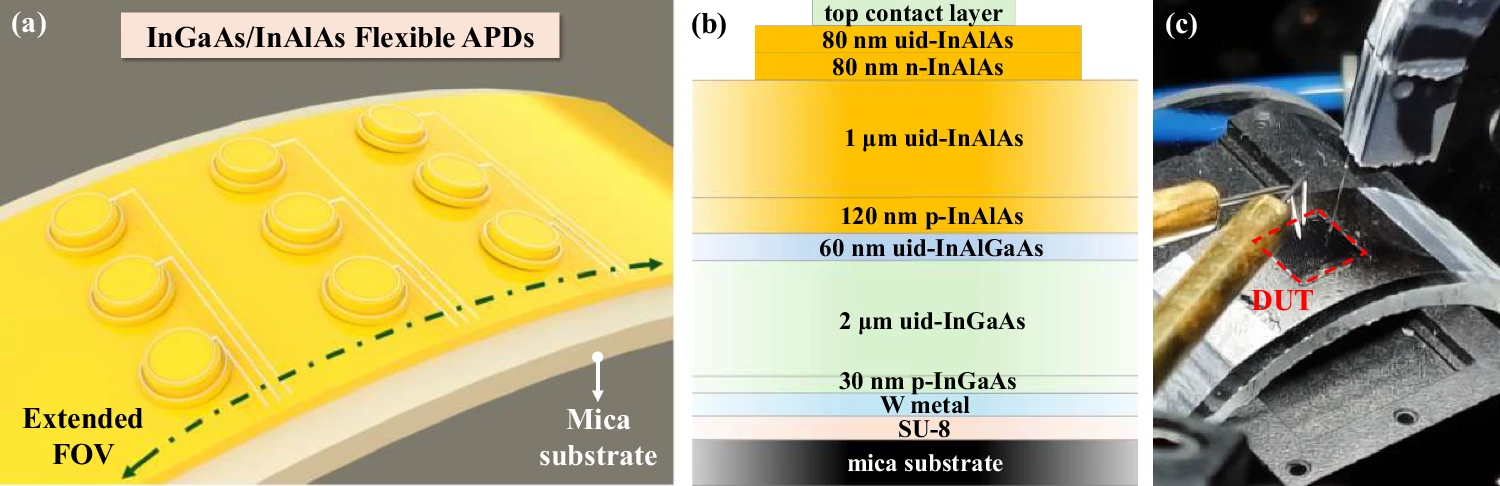
a The schematics of the proposed flexible InGaAs APD chip. b The schematic of the InGaAs/InAlAs APD featuring a separate-absorption-grading-charge-multiplication structure with a metal layer served as bottom metal contact and a reflector. c Optical image of the fabricated flexible APDs under test.

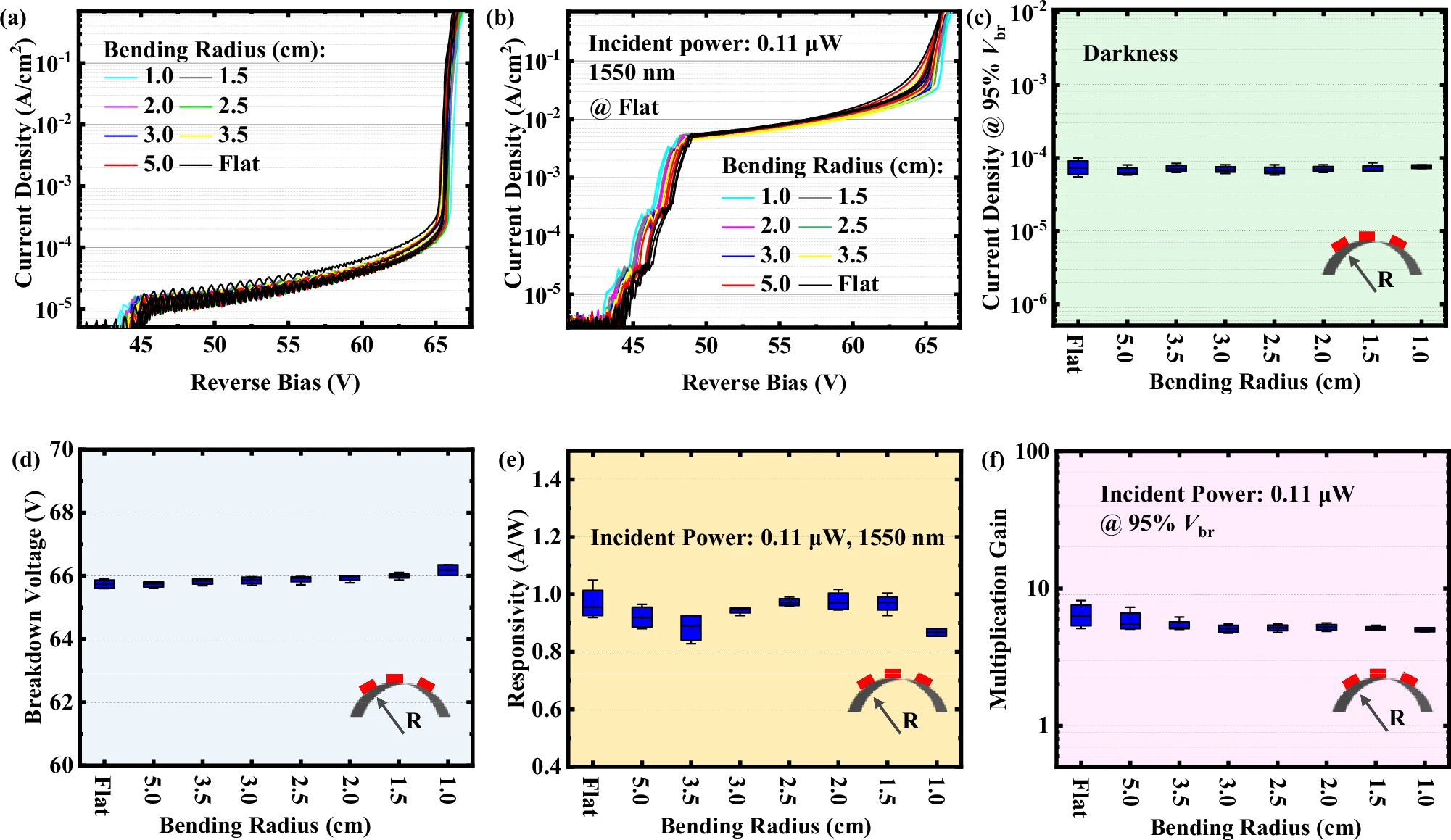
a Comparison of the Jdark–V curves under flat and bent conditions where the bending radius range from 5 to 1 cm. b Comparison of the Jtotal–V characteristics with the incident power of −39.6 dBm at the same bending radius. c Comparison of the dark current at 95% of Vbr at the same bending conditions. d Comparison of the breakdown voltage at the same bending conditions. e Comparison of the responsivity at unity gain at 1550 nm at the same bending conditions. f The multiplication gain at 95% of Vbr. The J–V curves show no significant changes at all flat and bent conditions.

Saturday, October 25, 2025

33rd IS&T Color and Imaging Conference Oct 27-31

https://imaging.org/IST/Conferences/CIC/CIC2025/CIC_Home.aspx

The 33rd Color and Imaging Conference will be held in Hong Kong—Monday 27 - Friday 31 October 2025—for the first time in Asia.

The CIC33 is organized around the following topics.

Color Perception and Cognition
Capture and Reproduction
Material and Color Appearance
Color in Illumination and Lighting
Color Theory
Image Quality
Multispectral Imaging
Specific Color Applications
Color in Computer Graphics
Color in Computer Vision
Motion Picture Imaging Pipeline 

Program Highlights 

KEYNOTE TALKS – Start Each Day Inspired
Oct 29
Mingxue Wang, Huawei Technologies
“Recent Development and Challenges of Smartphone Digital Imaging”
Oct 30
Shoji Tominaga, NTNU
“Colorimetry and Image Reproduction of Fluorescent Objects”
Oct 31
Hyeon-Jeong Suk, KAIST
“Skin Color in Culture and Technology”

EVENING TALK – Oct 29
Michael Freeman, Award-winning Photographer
“The Aesthetics of Imagery from the Real World”

Courses and Workshops

New Courses
SC01 Color Science Research and Application (Ronnier Luo and Minchen (Tommy) Wei)
SC02 Multimodal AI Essentials: Language, Vision, and Technical Use Cases (Orange Gao, Shida Yu, and Nanqi Gong, Amazon)
SC10 Camera Phone Image Quality (Jonathan B. Phillips)
SC12 Human Color Vision and Visual Processing and the Effects of Individual Differences (Andrew Stockman)
SC14 Color Grading for Photographers: From Perception to Practice (Marianna Santoni)
SC15 High Dynamic Range (HDR) Imaging: Capture, Standards, Display, and Color Management (Nicolas Bonnier, Paul Hubel, and Luke Wallis)

Hands-on Courses
SC02 Multimodal Al Essentials: Language, Vision, and Technical Use Cases (Orange Gao)
SC10 Camera Phone Image Quality (Jonathan B. Phillips)
SC11 Underwater Colorimetry (Derya Akkaynak)


Workshops
W1: Display Color Consistency and Individual Differences in Color Sensitivity (Francisco Imai and Shahram Peyvandi, convenors)
W2: Facial Appearance Measurement, Perception, and Applications (Yan Lu, convenor)
W3: New ICC Features in Real World Applications (Max Derhak, convenor)
W4: AR/MR/VR Color Perception and Rendering (Jiangtao Kuang and Kaida Xiao, convenors)

ST's new sensors for industrial automation, security, retail

https://newsroom.st.com/media-center/press-item.html/p4728.html

STMicroelectronics introduces a new family of 5MP CMOS image sensors: VD1943, VB1943, VD5943, and VB5943.

- Four new 5MP image sensors allow customers to optimize image capture with high speed, high detail with a single, flexible product instead of two chips
- New device family is ideal for high-speed automated manufacturing processes and object tracking
- New sensors leverage market-leading technology for both global and rolling shutter modes, with a compact 2.25µm pixel with advanced 3D stacking, and on-chip RGB-IR separation

Dual global and rolling shutter modes
The sensors provide hybrid global and rolling shutter modes, allowing developers to optimize image capture for specific application requirements. This functionality ensures motion-artifact-free video capture (global shutter) and low-noise, high-detail imaging (rolling shutter), making it ideal for high-speed object tracking and automated manufacturing processes.

Compact design with advanced pixel technology
Using 2.25 µm pixel technology and advanced 3D stacking, the sensors deliver high image quality in a smaller footprint. The die size is 5.76 mm by 4.46 mm, with a package size of 10.3 mm by 8.9 mm, and an industry-leading 73%-pixel array-to-die surface ratio. This compact design enables integration into space-constrained embedded vision systems without compromising performance.

On-chip RGB-IR separation
The RGB-IR variants of the sensors feature on-chip RGB-IR separation, eliminating the need for additional components and simplifying system design. This capability supports multiple output patterns, including 5MP RGB-NIR 4×4, 5MP RGB Bayer, 1.27MP NIR subsampling, and 5MP NIR smart upscale, with independent exposure times and instant output pattern switching. This integration reduces costs while maintaining full 5MP resolution for both color and infrared imaging.

Tuesday, October 21, 2025

[Video] Owl Thermal Imaging for Safer Streets


 Smarter Cameras Imply Safer Streets? | Interview with Wade Appelman, Owl Autonomous Imaging 

 Pedestrian deaths at night are rising around the world — and traditional car sensors aren't enough to stop them. In this eye-opening interview, we speak with Wade Appelman, Chief Business Officer at Owl Autonomous Imaging, about how thermal imaging and AI are working together to change that.

We explore:

  •     Why pedestrian safety at night is now a global concern
  •     How thermal cameras and convolutional neural networks (CNNs) work in real-time to detect people in low light
  •     How these smart systems integrate with vehicle software using ROS
  •     The technology behind monocular vision and its use in autonomous driving
  •     How advanced camera sensors are built — from microbolometers to full-scale production
  •     Real-world testing results from Detroit and Las Vegas that show how thermal vision outperforms lidar, radar, and regular RGB cameras


Monday, October 20, 2025

Single-Photon Challenge image reconstruction competition is now open!

The Single-Photon Challenge announced yesterday (Oct 19) at ICCV 2025 is a first-of-its-kind benchmark and open competition for photon-level imaging and reconstruction.

The competition is now open! The submission deadline is April 1, 2026 (AOE) and winners will be announced in summer 2026. 

The challenge provides access to single-photon datasets and a public leaderboard to benchmark algorithms for photon-efficient vision: https://SinglePhotonChallenge.com


For this image reconstruction challenge you will need to come up with a novel and creative ways to transform many single-photon camera frames into a single high quality image. This setting is very similar to traditional burst imaging but taken to its extreme limit. Instead of a few burst images you have access to a thousand, but the catch is that each input frame is extremely noisy.  

There are thousands of dollars in prizes to win, thanks to the sponsors Ubicept and Singular Photonics.

Thursday, October 16, 2025

Samsung announces 0.5um pixel

https://semiconductor.samsung.com/image-sensor/mobile-image-sensor/isocell-hp5/

Specifications:

Effective Resolution
 16,384 x 12,288 (200MP) 
Pixel Size
 0.5 μm 
Optical Format
 1/1.56" 
Color Filter
 Tetra²pixel RGB Bayer Pattern 
Normal Frame Rate
 7.5 fps @full, 30 fps @50MP, 90 fps @12.5MP 
Video Frame Rate
 30 fps @8K, 120 fps @4K, 480 fps @FHD (w/o AF) 
Shutter Type
 Electronic rolling shutter 
ADC Accuracy
 10-bit 
Supply Voltage
 2.2 V for analog, 1.8 V for I/O, 1.0 V for digital core supply 
Operating Temperature
 -20℃ to +85℃ 
Interface
 4 lanes (4.5 Gbps per lane) D-PHY / 3 trios (4 Gsps per trio) C-PHY 
Chroma
 Tetra²pixel 
Autofocus
 Super QPD (PDAF) 
HDR
 Smart-ISO Pro (iDCG), Staggered HDR 
Output Formats
 RAW8, RAW10, RAW12, RAW14 
Analog Gain
 16x @full, 256x @12.5MP

Excerpt from Baidu news (translated with Google translate): 

Samsung releases ISOCELL HP5, the world's first 0.5µm ultra-fine pixel 200 million image sensor

...  Samsung officially released the new 200-megapixel image sensor ISOCELL HP5, which is expected to be the first telephoto camera of the OPPO Find X9 Pro mobile phone.

... ISOCELL HP5 sensor is 1/1.56 inches in size, has an ultra-high resolution of 16384 x 12288, and compresses the unit pixel size to 0.5 microns. It is Samsung's first 200 million image sensor in the world equipped with 0.5µm ultra-micro pixels.

To overcome the challenges posed by small pixels, ISOCELL HP5 integrates multiple cutting-edge technologies. Among them, dual vertical transfer gate (D-VTG) and front deep trench isolation (FDTI) technologies work together to effectively increase the full well capacity of each pixel, or its ability to accommodate light signals. 

Tuesday, October 14, 2025

Tower Semiconductor preprint on 2.2um global shutter pixel

Yokoyama et al. from Tower Semiconductor have posted a preprint titled "Charge Domain Type 2.2um BSI Global Shutter Pixel with Dual Depth DTI Produced by Thick-Film Epitaxial Process":

Abstract: We developed a 2.2um Backside Illuminated (BSI) Global Shutter (GS) pixel with true charge-domain Correlated Double Sampling (CDS). A thick-film epitaxial deep DTI (Deep Trench Isolation) process was implemented to enhance 1/PLS (Parasitic Light Sensitivity) using a dual depth DTI structure.
The thickness of the epitaxial substrate was 8.5 um. This structure was designed using optical simulation. By using a thick epitaxial substrate, it is possible to reduce the amount of light that reaches the memory node. Dual-depth DTI, which shallows the DTI depth on the readout side, makes it possible to read signals from the PD to the memory node smoothly. To achieve this structure, we developed a process for thick epitaxial substrate, and the dual-depth DTI can be fabricated with a single mask. This newly developed pixel represents the smallest ever charge-domain GS pixel to date. Despite its compact size, this pixel achieved high QE (83%) and 1/PLS of over 10,000. The pixel maintains 80% of its peak QE at ±15 degrees. 1/PLS is stable even when the F# is small.

Full paper: https://sciprofiles.com/publication/view/7ae02d55ce8f3721ebfc8c35fb871d97 

Saturday, October 11, 2025

Conference List - April 2026

IEEE 23rd International Symposium on Biomedical Imaging - 8-11 April 2026 - London, UK - Website

SPIE Photonics Europe - 12-16 April 2026 - Strasbourg, France - Website

IEEE Silicon Photonics Conference - 13-15 April 2026 - Ottawa, Ontario, Canada - Website

IEEE Custom Integrated Circuits Conference - 19-22 April 2026 - Seattle, Washington, USA - Website

Compound Semiconductor International Conference - 20-22 April 2026 - Brussels. Belgium - Website

SPIE Defense + Security - 26-30 April 2026 - National Harbor, Maryland, USA - Website


If you know about additional local conferences, please add them as comments.

Return to Conference List index

Monday, October 06, 2025

Billion-pixel-resolution microscopy of curved surfaces

Recent Optical news article covers a publication by Yang et al. which presents a new technique for capturing high resolution microscopy images of curved surfaces. 

X. Yang, H. Chen, L. Kreiss, C.B. Cook, G. Kuczewski, M. Harfouche, M.O. Bohlen, R. Horstmeyer, “Curvature-adaptive gigapixel microscopy at submicron resolution and centimeter scale,” Opt. Lett., 50, 5977-5980 (2025).
DOI: 10.1364/OL.572466

New microscope captures large, high-resolution images of curved samples in single snapshot
Innovation promises faster insights for biology, medicine and industrial applications

Researchers have developed a new type of microscope that can acquire extremely large, high-resolution pictures of non-flat objects in a single snapshot. This innovation could speed up research and medical diagnostics or be useful in quality inspection applications.

“Although traditional microscopes assume the sample is perfectly flat, real-life samples such as tissue sections, plant samples or flexible materials may be curved, tilted or uneven,” said research team leader Roarke Horstmeyer from Duke University. “With our approach, it’s possible to adjust the focus across the sample, so that everything remains in focus even if the sample surface isn’t flat, while avoiding slow scanning or expensive special lenses.”

In the Optica Publishing Group journal Optics Letters, the researchers show that the microscope, which they call PANORAMA, can capture submicron details — 1/60 to 1/120 the diameter of a human hair — across an area roughly the size of a U.S. dime without moving the sample. It produces a detailed gigapixel-scale image, which has 10 to 50 times more pixels than the average smartphone camera image.

“This tool can be used wherever large-area, detailed imaging is needed. For instance, in medical pathology, it could scan entire tissue slides, such as those from a biopsy, at cellular resolution almost instantly,” said Haitao Chen, a doctoral student in Horstmeyer’s lab. “In materials science or industrial inspection, it could quickly inspect large surfaces such as a chip wafer at high detail.”


Friday, October 03, 2025

Webinar on metasurface optics design

Metasurface Optics for Information Processing and Computing
Presented by Shane Colburn
Thu, Oct 9, 2025 1:00P EDT


Optics has long played a central role in information processing, from early analog computing systems to modern optical imaging and communication platforms. Recent advancements in nanofabrication and wavefront control have enabled a new class of ultrathin optical elements known as metasurfaces, which significantly expand the design space for manipulating light. By tailoring local phase, amplitude, and polarization responses at subwavelength scales, metasurfaces offer a compact and highly controllable platform for performing complex transformations on optical wavefronts.

Metaoptics for optical information processing leverages co-design of optical elements and computational algorithms to perform operations typically handled in the digital domain. Metasurfaces can be engineered to modify the point spread function of imaging systems, enabling custom optical transformations that enhance task-specific performance. Convolutional metaoptics, in particular, allow spatial convolutions to be executed directly in the optical domain as part of a hybrid analog-digital pipeline. These approaches present opportunities for reducing latency and energy consumption in computational imaging and embedded vision systems. Key challenges remain in achieving robustness, scalability, and seamless integration with electronic hardware, motivating continued research at the intersection of optics, machine learning, and photonic device design.

Who should attend:
This session is ideal for professionals involved in research and development, optical engineering, photonic device development, computational imaging, machine learning for optics, and advanced nanofabrication. It is particularly relevant to those working with technologies such as metasurfaces, wavefront shaping, hybrid analog-digital imaging systems, convolutional metaoptics, embedded vision hardware, and optical information processing platforms.

About the presenter:
Shane Colburn received his Ph.D. in electrical engineering and completed his postdoctoral studies at the University of Washington. His research primarily focused on dielectric metasurfaces for computational imaging and information processing, emphasizing hybrid optical-digital systems that leverage the compact form factor offered by metasurfaces and the aberration mitigation capabilities of computational imaging. He developed design methods using metaoptics for object detection and performing convolutions in the optical domain. Additionally, he investigated methods for reconfiguring metasurfaces, including novel architectures, electromechanical tuning, and phase-change material metasurfaces.

Colburn was previously the director of optical design at Tunoptix, where he led the development of its proprietary designs and nanofabrication efforts for building robust, high-performance imaging systems using metaoptics. Colburn is now the founder and managing director of Edgedyne, a company that develops information processing technologies based on metaoptics and provides photonic design and consulting services to clients in a range of sectors, including telecommunications, semiconductor, remote sensing, medical imaging, and consumer electronics.

Thursday, October 02, 2025

Article about Japan's TDK and Apple iPhone cameras

Original article here: https://gori.me/iphone/iphone-news/161745

(Translated using google translate)

TDK's TMR Sensor is the Secret to iPhone Cameras, Tim Cook Praises About Japanese Technology

TDK reveals thirty years of technology accumulation and manufacturing process that competitors cannot imitate at the first release of Apple Yokohama Technology Center 

Apple CEO Tim Cook visited the Apple Yokohama Technology Center (YTC) in Tsunashima, Yokohama, during his visit to Japan. This is the first time that the facility has been opened to the public, and the reality of a state-of-the-art research and development center with about 6,000 square meters of lab space and a clean room has been revealed.

On the same day, YTC presented four of Apple's leading companies—TDK, AGC, Kyocera, and Sony Semiconductor Solutions— that support Apple’s innovation. Tim Cook told reporters, “Apple will never be happy with the situation. Continue to ask for something better. The same goes for Japanese companies. We will never be satisfied and will continue to develop with the aim of always further advancement,” he said, emphasizing the importance of collaborative relationships with Japanese companies. 

The partnership between TDK and Apple began before the first iPod and has been in a long-term relationship for more than three decades. Today, almost all Apple products use TDK technology, and contribute to a wide range of fields, including batteries, pass filters, inductors, microphones, and various sensors.

It’s worth noting that TDK uses 100% renewable energy in all of its products it manufactures for Apple products. In the background of the beautiful photo shoot of the iPhone, which is usually used casually, and the ultra-compact part called the TMR sensor developed by TDK functions as a technology that all iPhone users benefit from.

TMR sensor stands for “Tunnel Magnetoresistance Sensor” and is an ultra-small sensor that detects changes in magnetic fields with extremely high sensitivity. It is so small that it contains fifty thousand wine glasses in a glass of wine, and it is a size that is almost invisible to the naked eye.

The principle of operation of this sensor applies quantum mechanical phenomena. To put it simply, it is a structure in which an ultra-thin insulator is sandwiched between two magnetic materials , and the electrical resistance changes dramatically due to changes in the external magnetic field. Compared to conventional Hall elements, the TMR sensor has reached about a hundred times the sensitivity of the TMR sensor, and it is characterized by extremely clear reactions such as "zero or one". 

The experience of automatically focusing on the moment you launch the camera app on your iPhone and point the lens at the subject will be "natural" that many users feel on a daily basis. However, in this background, the TMR sensor accurately grasps the position of the lens in a thousandth of a second.

The specific mechanisms are as follows. When the lens moves back and forth, a small magnet moves with the lens. The TMR sensor detects the distance change with this magnet as a change in the magnetic field as a change in the magnetic field, and instantly grasps where the lens is now. The camera system makes appropriate focus adjustments by "detecting the position" rather than measuring the distance.

The TMR sensor, which was first used for autofocus applications on the iPhone X, has also been applied to the sensor shift image stabilization (OIS) from the iPhone 12 series. The minute movement due to the camera shake is also instantly detected, and the sensor itself is operated to correct it.

The latest iPhone 17 series also uses TMR sensors for the center stage function of the front camera, which detects the fine movement of the lens in real time with a sensitivity of 100 times more than general hall elements. 

An easy example of an easy-to-understand TMR sensor is the joystick of the game controller. In the conventional joystick, a mechanical part called a "potension meter" is used, and the angle is detected by physical contact.

On the other hand, joysticks using TMR sensors operate non-contact , which greatly improves response speed and accuracy. In addition, since there is no mechanical wear, it also realizes durability that does not deteriorate in accuracy even if it is used for a long time.

The structure of the TMR sensor itself can be understood by the competitors when it is disassembled. However, it is very difficult to actually produce an equivalent product. The reason is TDK’s proprietary manufacturing process technology.

Semiconductor-based equipment is used for manufacturing, but it is not the equipment itself that is important. Combining multiple specialized technologies such as TMR deposition, magnetic material plating, and dry etching, the process of creating a unique layered structure that detects the magnetic field from which direction it detects the magnetic field from and which direction does it not perceives it is at the core. 

Modern smartphones are becoming thinner, and many magnets are used inside. There may be concerns about whether the delicate TMR sensor will work properly in this environment.

TDK cooperates closely from the customer's design stage to propose optimal sensor placement and design . The influence of the magnetic field is rapidly weakened by simply securing 1cm of physical distance, so the interference problem can be solved with proper design. He visits Cupertino fourteen times a year, and his close work with Apple’s camera team is proof of that. 

TDK has leveraged ninety years of expertise in magnetic materials to establish this process technology. The TMR sensors manufactured at the Asama Techno Plant in Japan also have a sustainable manufacturing system using 100% renewable energy.

The background of each photo that iPhone users casually take is the result of such a long-term accumulation of Japanese precision technology and technology. TMR sensors are by no means a prominent component, but they will continue to evolve as an important technology that supports the modern smartphone experience. 
Wednesday, October 01, 2025

Sony announces IMX927 a 105MP global-shutter CIS

Product page: https://www.sony-semicon.com/en/products/is/industry/gs/imx927-937.html

Release page: https://www.sony-semicon.com/en/info/2025/2025092901.html 

PetaPixel article: https://petapixel.com/2025/09/29/sonys-new-global-shutter-sensor-captures-105-megapixels-at-100fps/ 

Sony Semiconductor Solutions to Release the Industry-Leading Global Shutter CMOS Image Sensor for Industrial Use That Achieves Both Approximately 105-Effective-Megapixels and High-Speed 100 FPS Output

Delivering high-resolution and high-frame-rate imaging to contribute to diversified, advanced inspections 

Atsugi, Japan — Sony Semiconductor Solutions Corporation (Sony) today announced the upcoming release of the IMX927 stacked CMOS sensor with back-illuminated pixel structure and global shutter. It is the industry-leading sensor that achieves both high-resolution of approximately 105-effective-megapixels and high-speed output at a maximum frame rate of 100 fps.

The new sensor product is equipped with Pregius S™ global shutter technology made possible by Sony’s original pixel structure, ensuring high-quality imaging performance with distortion free imaging and minimal noise. By optimizing the sensor drive in pixel reading and A/D converter, it supports high-speed image data output. Introducing this high-resolution and high-frame-rate model into the product lineup will help improving productivity in industrial equipment domain, where recognition targets and inspection methods continue to diversify.

With the automation of factories progressing, the need for machine vision cameras that can capture a variety of objects at high speed and high resolution is growing in industrial equipment domain. With its proprietary back-illuminated pixel structure, Sony’s global shutter CMOS image sensors deliver high sensitivity and saturation capacity. Because they can capture moving subjects at high resolution without distortion, they are increasingly being used in a wide range of applications such as precision component recognition and foreign matter inspection. The new IMX927 features a high resolution of approximately 105 effective megapixels while delivering a high frame rate of up to 100 fps, helping shorten measurement and inspection times. It also shows promise in advanced measurement and inspection applications, for instance imaging larger objects in high resolution and three-dimensional inspection using multiple sets of image data. 

Along with the IMX927, Sony will also release seven products with different image sizes and frame rates. It has also developed a new ceramic package with connector that is compatible with a series of all these products, which allows cameras to be designed with sensors removable from camera modules. This can contribute to streamlining camera assembly and sensor replacement. By expanding its global shutter product lineup, Sony is contributing to the advancement of industrial equipment, where recognition and inspection tasks continue to become ever more precise and diversified.

Main Features
■ Global shutter technology with Sony’s proprietary pixel structure for high-resolution and high-sensitivity imaging
The new sensor is equipped with Pregius S global shutter technology. The very small 2.74 μm hat use Sony’s proprietary back-illuminated pixels and stacked structure enable the approximately 105-effective-megapixels resolution in a compact size with a high level of sensitivity and saturation capacity. In addition to inspections of precision components such as semiconductors and flat-panel displays, which require a high degree of accuracy, this feature also enables the capture of larger objects with distortion free, high-resolution, low-noise images. Thereby machine vision cameras can achieve higher precision measurement and inspection processes in a wide range of applications.
■ Circuit structure enabling a highly efficient sensor drive that saves power and makes high-speed imaging possible
The new sensor employs a circuit structure that optimizes pixel reading and sensor drive in the A/D converter, which saves power and enables faster data processing. This design makes a high-speed frame rate of up to 100 fps possible, reducing the time to output image data for more efficiency in measurement and inspection tasks. It also shows promise for application in advanced inspections such as three-dimensional inspections, which use multiple image data sets.
■ New ceramic package with connector to streamline camera assembly and contribute to stable operation
Sony has also developed a new ceramic package with connector, which is compatible with a series of eight products including the IMX927, making it possible to combine or detach sensors from camera modules flexibly to design cameras. Using this package makes camera assembly easier and streamlines the process of replacing sensors to suit camera specifications. It also has a superior heat dissipation structure, which suppresses the impact of heat on camera performance, contributing to stable, long-term operation.