
Tuesday, June 05, 2012
Omnivision Applies for Pipelined Readout Patent
Omnivision's patent application US20120113306 proposes to increase the sensor's speed by pipelining the readout and ADC circuits, so that the next pixel output can be read while column ADC processes the previous sample. To me, the idea is quite obvious and was used in sensors well before the priority date of Nov. 2010:

Monday, June 04, 2012
e2v: QE Advances Night Vision Sensors
Photonics.com published e2v article "Quantum Efficiency Advances Sensors for Night Vision" by Frederic DeVriere, marketing manager for aerospace and defense imaging at e2v in Grenoble, France. The mentioned sensors are electron-bombardment CMOS and CCD for use with image intensifiers, EMCCDs and the new e2v Ruby series with enhanced IR response.
 |
| Nightglow Spectrum |
How to Measure Temporal Noise in Dark
Albert Theuwissen continues his excellent series of "How to Measure..." articles. The latest one talks about temporal noise in dark, its sources, measurement and interpretations.
Transparency Market Research Talks about US Image Sensor Market
Transparency Market Research released an unusual image sensor market report named "Image Sensors Market - The U.S. Industry Analysis Market Share, Trends And Forecast, 2011 - 2017". Few quotes (exactly as written in the report's announcement):
"Image sensors are primarily categorized as CCD image sensors (area image sensor), linear image sensors and X-ray image sensors. The linear image sensor segmented is subdivided into CMOS image sensors, NMOS image sensors and InGaAs image sensors. The linear image sensor is the largest segment; accounting for about 84.2% of the U.S. images sensor market in 2011, largely due to CMOS image sensors, which accounts for more than 90% of the linear image sensor market in the same year. The CMOS (Complementary Metal Oxide Semiconductors) image sensors segment dominates the U.S. linear image sensor market with more than 90% share."

"Portable applications accounts for the largest share of the U.S. image sensors applications followed by toys astronomy. ...Mobile handsets are the leading application for CMOS sensors, representing more than 75% of the total CMOS shipments in 2011. The use of CCD technology will shrink from 14% in 2011 to just 1.3% by 2017."
"Image sensor prices have shown a downward trend over the last few years and are expected to have a similar trend over the next few years. The average selling price per unit of overall image sensors in the U.S. stood at USD 3.9 in 2011. Average cost per unit for CMOS image sensors in the same year was USD 3.5 whereas average cost of CCD image sensors was USD 8.3 per unit."
"Image sensors are primarily categorized as CCD image sensors (area image sensor), linear image sensors and X-ray image sensors. The linear image sensor segmented is subdivided into CMOS image sensors, NMOS image sensors and InGaAs image sensors. The linear image sensor is the largest segment; accounting for about 84.2% of the U.S. images sensor market in 2011, largely due to CMOS image sensors, which accounts for more than 90% of the linear image sensor market in the same year. The CMOS (Complementary Metal Oxide Semiconductors) image sensors segment dominates the U.S. linear image sensor market with more than 90% share."

"Portable applications accounts for the largest share of the U.S. image sensors applications followed by toys astronomy. ...Mobile handsets are the leading application for CMOS sensors, representing more than 75% of the total CMOS shipments in 2011. The use of CCD technology will shrink from 14% in 2011 to just 1.3% by 2017."
"Image sensor prices have shown a downward trend over the last few years and are expected to have a similar trend over the next few years. The average selling price per unit of overall image sensors in the U.S. stood at USD 3.9 in 2011. Average cost per unit for CMOS image sensors in the same year was USD 3.5 whereas average cost of CCD image sensors was USD 8.3 per unit."
Omnivision and Marvel Present Wireless Skype IP Camera Platform
OmniVision and Marvell launch a wireless Skype IP security camera, designed to allow smartphones, tablets and notebooks to remotely access the camera’s video feed over the Internet. Built on OmniVision’s OmniPixel3-HS pixel, OV7740 VGA sensor captures video at 60fps and sends the data to the OV780 video and audio processor for high quality video compression. The Marvell PXA168 application processor supports the Skype platform, allowing the IP camera to act as a Skype video phone, while the Marvell Avastar 88W8787 network solution enables video transmission over any high-speed Wi-Fi network.
Finished cameras using this reference design are available now from manufacturers.
Finished cameras using this reference design are available now from manufacturers.
InVisage in Red Herring Top 100 North America Tech Startups
Market Wire: InVisage announces it has been named a Red Herring Top 100 North America Tech Startups list.
"We set out to create a technology that would help people capture their important moments with a device they carry around all the time, which meant abandoning the constraints of legacy design," says Jess Lee, CEO, InVisage. "The result is QuantumFilm, a huge leap forward in the digital imaging world. We're very proud to be honored by Red Herring."
Red Herring's editorial staff evaluated the companies on both quantitative and qualitative criteria, such as financial performance, technology innovation, management quality, strategy, and market penetration.
"We set out to create a technology that would help people capture their important moments with a device they carry around all the time, which meant abandoning the constraints of legacy design," says Jess Lee, CEO, InVisage. "The result is QuantumFilm, a huge leap forward in the digital imaging world. We're very proud to be honored by Red Herring."
Red Herring's editorial staff evaluated the companies on both quantitative and qualitative criteria, such as financial performance, technology innovation, management quality, strategy, and market penetration.
Sunday, June 03, 2012
Sony Sensor Inside New Samsung Galaxy SIII
Chipworks reverse engineering revealed that Galaxy SIII 8MP 1.4um pixel primary sensor is made by Sony:
"This sensor had a different bond pad layout than the other similar Sony devices we have analyzed but it had identical die markings."

"This sensor had a different bond pad layout than the other similar Sony devices we have analyzed but it had identical die markings."

Friday, June 01, 2012
Emmy Award for CMOS Sensor Advances
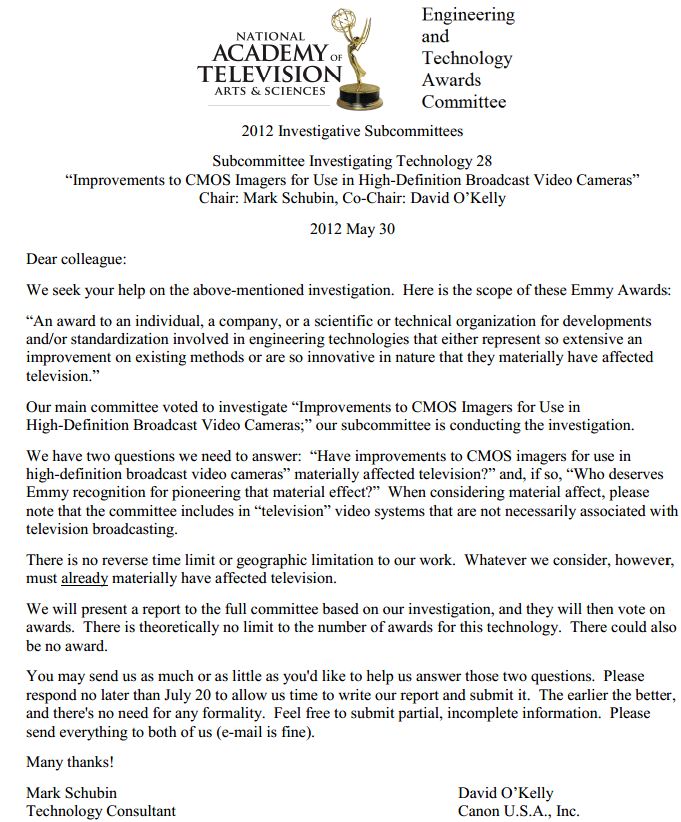
I've received an email on investigation of "Improvements to CMOS Imagers for Use in High-Definition Broadcast Video Cameras" for possible Emmy-award recognition. It might make sense to open the discussion, so everybody can express her/his opinion, anonymous or not. One of the major questions the investigators are interested is "whether the improvements to HD CMOS sensors for use in broadcast video cameras "materially have affected television."
Dear colleague:
We seek your help on the above-mentioned investigation. Here is the scope of these Emmy Awards:
“An award to an individual, a company, or a scientific or technical organization for developments and/or standardization involved in engineering technologies that either represent so extensive an improvement on existing methods or are so innovative in nature that they materially have affected television.”
Our main committee voted to investigate “Improvements to CMOS Imagers for Use in High-Definition Broadcast Video Cameras;” our subcommittee is conducting the investigation.
We have two questions we need to answer: “Have improvements to CMOS imagers for use in high-definition broadcast video cameras” materially affected television?” and, if so, “Who deserves Emmy recognition for pioneering that material effect?” When considering material affect, please note that the committee includes in “television” video systems that are not necessarily associated with television broadcasting.
There is no reverse time limit or geographic limitation to our work. Whatever we consider, however, must already materially have affected television.
We will present a report to the full committee based on our investigation, and they will then vote on awards. There is theoretically no limit to the number of awards for this technology. There could also be no award.
You may send us as much or as little as you'd like to help us answer those two questions. Please respond no later than July 20 to allow us time to write our report and submit it. The earlier the better, and there's no need for any formality. Feel free to submit partial, incomplete information. Please send everything to both of us (e-mail is fine).
Many thanks!
Mark Schubin
Technology Consultant
David O’Kelly
Canon U.S.A., Inc.
-------
The emails are withheld and available on request, in case somebody wants to send the answer directly.

2012 Investigative Subcommittees
Subcommittee Investigating Technology 28
“Improvements to CMOS Imagers for Use in High-Definition Broadcast Video Cameras”
Chair: Mark Schubin, Co-Chair: David O’Kelly
2012 May 30
Dear colleague:
We seek your help on the above-mentioned investigation. Here is the scope of these Emmy Awards:
“An award to an individual, a company, or a scientific or technical organization for developments and/or standardization involved in engineering technologies that either represent so extensive an improvement on existing methods or are so innovative in nature that they materially have affected television.”
Our main committee voted to investigate “Improvements to CMOS Imagers for Use in High-Definition Broadcast Video Cameras;” our subcommittee is conducting the investigation.
We have two questions we need to answer: “Have improvements to CMOS imagers for use in high-definition broadcast video cameras” materially affected television?” and, if so, “Who deserves Emmy recognition for pioneering that material effect?” When considering material affect, please note that the committee includes in “television” video systems that are not necessarily associated with television broadcasting.
There is no reverse time limit or geographic limitation to our work. Whatever we consider, however, must already materially have affected television.
We will present a report to the full committee based on our investigation, and they will then vote on awards. There is theoretically no limit to the number of awards for this technology. There could also be no award.
You may send us as much or as little as you'd like to help us answer those two questions. Please respond no later than July 20 to allow us time to write our report and submit it. The earlier the better, and there's no need for any formality. Feel free to submit partial, incomplete information. Please send everything to both of us (e-mail is fine).
Many thanks!
Mark Schubin
Technology Consultant
David O’Kelly
Canon U.S.A., Inc.
-------
The emails are withheld and available on request, in case somebody wants to send the answer directly.
Omnivision Reports Quarterly Results, Promises New "Watershed" Applications
Reuters: OmniVision reported a quarterly profit that missed Wall Street expectations and forecast weak earnings for the current quarter, as inventory write-downs dented its gross margins. OmniVision's net income for the quarter was $2.7 million, or 5 cents per share, compared with $34 million, or 56 cents a share, a year earlier. Revenue fell 15 percent to $218.5 million. Analysts expected earnings of 22 cents a share, on revenue of $205.4 million. Gross margin for the fourth quarter fell to 22.5%, from 30.7% a year earlier.
The company expects next quarter revenue of $235M to $255M, while analysts are expecting $219.2M.
SeekingAlpha earnings call transcript gives more details:
Shaw Hong, CEO:
"...there are challenges face OmniVision in the near term, specifically our corporate gross margin is under pressure. We have already launched multiple programs to improve our performance. These actions range from more aggressive development in integrated imaging solutions to more vigorously efforts to increase production yield. These measures may take time to produce favorable results, but we are committed to once again expanding our gross margins."
"...we are currently a leader in the mobile phone market, especially in the smartphone product category, and have had considerable success in the notebook and the entertainment market, our ongoing objective is to diversify our revenue stream into other promising markets. (inaudible) we see more opportunities in the automotive and medical markets."
Anson Chan, CFO:
"BSI-2 devices being such a complicated sensor on cost structure, it's actually very high at the moment. This is something that we have to battle, and obviously we are doing everything we can just that we won't be able to fix it immediately."
"I won't say it's all because of yield though, it's simply because the part is complicated and so there are a lot of effecting steps involved. And our whole supply chain also, they have new equipment and whatnot."
Q&A session had some tough questions:
Betsy Van Hees – Wedbush Securities:
"...if I remember correctly last summer, and you guys were talking about BSI-2 and talking about your expertise in being able to resolve problems quickly, and here we are today and we’re talking about -- and Anson I thought I remember you having [the caveat] here about the concerns that you have in terms of yield losses as you’re producing these products. So I was wondering if you could talk about what’s different between last summer and this summer."
Anson Chan, CFO:
"...the BSI-2 device that we were dealing with last summer, it's not even the same device that we’re dealing with today. So, you are going to have design changes, you are going to have layout issues, production steps that are all a little different, and all these little differences that add up to a new process overall for our supply chain."
Paul Coster – JPMorgan:
"...we’re all pretty confused here. It sounds to me like there’s something structurally different about these new products from BSI-2 in terms of the supply chain that cannot be fixed by you."
Anson Chan, CFO:
"It is fundamentally different, because this is 12-inch versus 8-inch, so our entire supply chain, they have to -- particularly when this time when we have to increase capacity upon -- to bring in new equipment. So, everyone has to go through the whole depreciation process and so forth and recover all the investment."
And then there is a teaser about a new watershed application area:
Ray Cisneros, VP of Worldwide sales:
"Other novel products using OmniVision sensors will soon be launched into the marketplace. Some of these designs represent a watershed point in how image sensors are used. Capturing an image is not the only application for a CMOS image sensor, and future tier 1 OEMs will demonstrate that in upcoming quarters."
The company expects next quarter revenue of $235M to $255M, while analysts are expecting $219.2M.
SeekingAlpha earnings call transcript gives more details:
Shaw Hong, CEO:
"...there are challenges face OmniVision in the near term, specifically our corporate gross margin is under pressure. We have already launched multiple programs to improve our performance. These actions range from more aggressive development in integrated imaging solutions to more vigorously efforts to increase production yield. These measures may take time to produce favorable results, but we are committed to once again expanding our gross margins."
"...we are currently a leader in the mobile phone market, especially in the smartphone product category, and have had considerable success in the notebook and the entertainment market, our ongoing objective is to diversify our revenue stream into other promising markets. (inaudible) we see more opportunities in the automotive and medical markets."
Anson Chan, CFO:
"BSI-2 devices being such a complicated sensor on cost structure, it's actually very high at the moment. This is something that we have to battle, and obviously we are doing everything we can just that we won't be able to fix it immediately."
"I won't say it's all because of yield though, it's simply because the part is complicated and so there are a lot of effecting steps involved. And our whole supply chain also, they have new equipment and whatnot."
Q&A session had some tough questions:
Betsy Van Hees – Wedbush Securities:
"...if I remember correctly last summer, and you guys were talking about BSI-2 and talking about your expertise in being able to resolve problems quickly, and here we are today and we’re talking about -- and Anson I thought I remember you having [the caveat] here about the concerns that you have in terms of yield losses as you’re producing these products. So I was wondering if you could talk about what’s different between last summer and this summer."
Anson Chan, CFO:
"...the BSI-2 device that we were dealing with last summer, it's not even the same device that we’re dealing with today. So, you are going to have design changes, you are going to have layout issues, production steps that are all a little different, and all these little differences that add up to a new process overall for our supply chain."
Paul Coster – JPMorgan:
"...we’re all pretty confused here. It sounds to me like there’s something structurally different about these new products from BSI-2 in terms of the supply chain that cannot be fixed by you."
Anson Chan, CFO:
"It is fundamentally different, because this is 12-inch versus 8-inch, so our entire supply chain, they have to -- particularly when this time when we have to increase capacity upon -- to bring in new equipment. So, everyone has to go through the whole depreciation process and so forth and recover all the investment."
And then there is a teaser about a new watershed application area:
Ray Cisneros, VP of Worldwide sales:
"Other novel products using OmniVision sensors will soon be launched into the marketplace. Some of these designs represent a watershed point in how image sensors are used. Capturing an image is not the only application for a CMOS image sensor, and future tier 1 OEMs will demonstrate that in upcoming quarters."
Subscribe to:
Comments (Atom)