Wednesday, August 17, 2022

RMCW LiDAR

Baraja is an automotive LiDAR company headquartered in Australia which specializes in pseudo-random modulation continuous wave LiDAR technology which they call "RMCW". A blog post by Cibby Pulikkaseril (Founder & CTO of Baraja) compares and contrasts RMCW with the more-commonly-known FMCW and ToF LiDAR technologies.

tldr; There's good reason to believe that pseudo-random modulation can provide robustness in multi-camera environments where multiple LiDARs are trying to transmit/receive over a common shared channel (free space).

Full blog article here: https://www.baraja.com/en/blog/rmcw-lidar

Some excerpts:

Definition of RMCW

Random modulated continuous wave (RMCW) LiDAR is a technique published in Applied Optics by Takeuchi et al. in 1983. The idea was to take a continuous wave laser, and modulate it with a pseudo-random binary sequence before shooting it out into the environment; the returned signal would be correlated against the known sequence and the delay would indicate the range to target. 

Benefits

... correlation turns the pseudo-random signal, which to the human eye, looks just like noise, into a sharp pulse, providing excellent range resolution and precision. Thus, by using low-speed electronics, we can achieve the same pulse performance used by frequency-modulated continuous wave (FMCW) LiDARs... .

... incredible immunity to interference, and this can be dialed in by software.

RMCW vs. FMCW vs. ToF

... [FMCW and RMCW] are fundamentally different modulation techniques. FMCW LiDAR sensors will modulate the frequency of the laser light, a relatively complicated operation, and then attempt to recognize the modulation in the return signal from the environment.

Both RMCW and FMCW LiDAR offer extremely high immunity from interfering lasers – compared to conventional ToF LiDARs, which are extremely vulnerable to interference.

Spectrum-Scan™ + RMCW is also able to produce instantaneous velocity information per-pixel, also known as Doppler velocity ... something not [natively] possible with conventional LiDAR... .


Baraja's Spectrum OffRoad LiDARs are currently available.


Spectrum HD25 LiDAR samples (specs in image below) will be available in 2022.

Monday, August 15, 2022

New understanding of color perception theory

From phys.org a news article about a recent paper that casts doubt on the traditional understanding of how human color perception works: "Math error: A new study overturns 100-year-old understanding of color perception":

A new study corrects an important error in the 3D mathematical space developed by the Nobel Prize-winning physicist Erwin Schrödinger and others, and used by scientists and industry for more than 100 years to describe how your eye distinguishes one color from another. The research has the potential to boost scientific data visualizations, improve TVs and recalibrate the textile and paint industries.

The full paper appears in the Proceedings of the National Academy of Sciences vol. 119 no. 18 (2022). It is titled "The non-Riemannian nature of perceptual color space" authored by Dr. Roxana Bujack and colleagues at Los Alamos National Lab.

The scientific community generally agrees on the theory, introduced by Riemann and furthered by Helmholtz and Schrödinger, that perceived color space is not Euclidean but rather, a three-dimensional Riemannian space. We show that the principle of diminishing returns applies to human color perception. This means that large color differences cannot be derived by adding a series of small steps, and therefore, perceptual color space cannot be described by a Riemannian geometry. This finding is inconsistent with the current approaches to modeling perceptual color space. Therefore, the assumed shape of color space requires a paradigm shift. Consequences of this apply to color metrics that are currently used in image and video processing, color mapping, and the paint and textile industries. These metrics are valid only for small differences. Rethinking them outside of a Riemannian setting could provide a path to extending them to large differences. This finding further hints at the existence of a second-order Weber–Fechner law describing perceived differences.


The key observation that this paper rests on is the concept of "diminishing returns". Statistical analysis of experimental data collected in this paper suggests that the perceived difference between pairs of colors A, B and C that lie along a single shortest path (geodesic) do not satisfy the additive equality.

A commentary by Dr. David Brainard (U. Penn.) about this paper was published in PNAS and is available here: https://color2.psych.upenn.edu/brainard/papers/2022-BrainardPNASCommentary.pdf

Some of the caveats noted in this commentary piece:

First, the authors make a first principles assumption that the achromatic locus is a geodesic and use this in their choice of stimuli. This assumption is intuitively appealing in that it would be surprising that the shortest path in color space between two achromatic stimuli would involve a detour through a chromatic stimulus and back. However, the achromatic locus as a geodesic was not empirically established, and more work could be considered to shore up this aspect of the argument. Second, the data were collected using online methods and combined across subjects prior to the analysis. This raises the question of whether the aggregate performance analyzed could be non-Riemannian even when the performance of each individual subject was itself Riemannian. Although it is not immediately obvious whether this could occur, it might be further considered as a possibility.

Phys.org press release: https://phys.org/news/2022-08-math-error-overturns-year-old-perception.html

LANL press release: https://discover.lanl.gov/news/0810-color-perception

PNAS paper: https://www.pnas.org/doi/10.1073/pnas.2119753119

Monday, August 08, 2022

Direct ToF Single-Photon Imaging (IEEE TED June 2022)

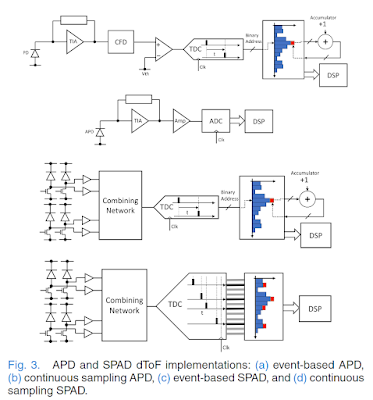
The June 2022 issue of IEEE Trans. Electron. Devices has an invited paper titled Direct Time-of-Flight Single-Photon Imaging by Istvan Gyongy et al. from University of Edinburgh and STMicroelectronics. 

This is a comprehensive tutorial-style article on single-photon 3D imaging which includes a description of the image formation model starting from first principles and practical system design considerations such as photon budget and power requirements.

Abstract: This article provides a tutorial introduction to the direct Time-of-Flight (dToF) signal chain and typical artifacts introduced due to detector and processing electronic limitations. We outline the memory requirements of embedded histograms related to desired precision and detectability, which are often the limiting factor in the array resolution. A survey of integrated CMOS dToF arrays is provided highlighting future prospects to further scaling through process optimization or smart embedded processing.


Tuesday, August 02, 2022

CFP: International Workshop on Image Sensors and Imaging Systems 2022

The 5th International Workshop on Image Sensors and Imaging Systems (IWISS2022) will be held in December 2022 in Japan. This workshop is co-sponsored by IISS.


-Frontiers in image sensors based on conceptual breakthroughs inspired by applications-

Date: December 12 (Mon) and 13 (Tue), 2022

Venue: Sanaru Hall, Hamamatsu Campus, Shizuoka University 

Access: see https://www.eng.shizuoka.ac.jp/en_other/access/

Address: 3-5-1 Johoku, Nakaku, Hamamatsu, 432-8561 JAPAN

Official language: English


Overview

In this workshop, people from various research fields, such as image sensing, imaging systems, optics, photonics, computer vision, and computational photography/imaging, come together to discuss the future and frontiers of image sensor technologies in order to explore the continuous progress and diversity in image sensors engineering and state-of-the-art and emerging imaging systems technologies. The workshop is composed of invited talks and a poster session. We are accepting approximately 20 poster papers, whose submission starts in August, with deadline on October 14 (Fri), 2022. A Poster Presentation Award will be given to the selected excellent paper. We encourage everyone to submit the latest original work. Every participant is required to register online by December 5 (Mon), 2022. On-site registration is NOT accepted. Since the workshop is operated by a limited number of volunteers, we can offer only minimal service; therefore, no invitation letters for visa applications to enter Japan can be issued.

Latest Information: Call for Paper, Advance Program
http://www.i-photonics.jp/meetings.html#20221212IWISS

Poster Session
Submit a paper: https://www.ite.or.jp/ken/form/index.php?tgs_regid=faf9bc5bde5e430962d98b110ccac65c5ddc6ca5718edb7c80089461c48b9cfa&tgid=ITE-IST&lang=eng&now=20220719133618
Submission deadline: Oct. 14(Fri), 2022 (Only title, authors, and short abstract are required)
Please use the above English page. DO NOT follow the Japanese instructions at the bottom of the page.
Notification of acceptance: by Oct. 21 (Fri)

Manuscript submission deadline: Nov. 21 (Mon), 2022 (2-page English proceeding is required)
One excellent poster will be awarded.

Plenary and Invited Speakers

[Plenary] 

“Deep sensing - Jointly optimize imaging and processing –“ by
Hajime Nagahara (Osaka University, Japan)


[Invited Talks]
- Image Sensors
“InGaAs/InP and Ge-on-Si SPADs for SWIR applications” by Alberto Tosi (Politecnico di Milano, Italy)
“CMOS SPAD-Based LiDAR Sensors with Zoom Histogramming TDC Architectures” by Seong-Jin Kim et al. (UNIST, Korea)
"TBD" by Min-Sun Keel (Samsung Electronics, Korea)
“Modeling and verification of a photon-counting LiDAR” by Sheng-Di Lin (National Yang Ming Chiao Tung Univ., Taiwan)
- Computational Photography/Imaging and applications “Computational lensless imaging by coded optics” by Tomoya Nakamura (Osaka Univ., Japan)
“TBD” by Miguel H. Conde (Siegen Univ.) “TBD” by TBD (Toronto Univ.)
 

- Optics and Photonics
“Optical system integrated time-of-flight and optical coherence tomography for high-dynamic range distance measurement” by Yoshio Hayasaki et al. (Utsunomiya Univ., Japan)
“High-speed/ultrafast holographic imaging using an image sensor” by Yasuhiro Awatsuji et al. (Kyoto Institute of Technology, Japan)
“Near-infrared sensitivity improvement by plasmonic diffraction technology” by Nobukazu Teranishi et al. (Shizuoka Univ, Japan)


Scope
- Image sensor technologies: fabrication process, circuitry, architectures
- Imaging systems and image sensor applications
- Optics and photonics: nanophotonics, plasmonics, microscopy, spectroscopy
- Computational photography/ imaging
- Applications and related topics on image sensors and imaging systems: e.g., multi-spectral imaging, ultrafast imaging, biomedical imaging, IoT, VR/AR, deep learning, ...

Online Registration for Audience
Registration is necessary due to the limited number of available seats.
Registration deadline is Dec. 5 (Mon).
Register and pay online from the following website: <to appear>

Registration Fee
Regular and student: approximately 2,000-yen (~15 USD)
Note: This price is for purchasing the online proceeding of IWISS2022 through the ITE. If you cannot join the workshop due to any reason, no refund will be provided.

Collaboration with MDPI Sensors Special Issue
Special Issue on "Recent Advances in CMOS Image Sensor"
Special issue editor: Dr. De Xing Lioe
Paper submission deadline: Feb. 25 (Sat), 2023
https://www.mdpi.com/journal/sensors/special_issues/CMOS_image_sensor
The poster presenters are encouraged to submit a paper to this special issue!
Note-1: Those who do not give a presentation in the IWISS2022 poster session are also welcome to submit a paper!
Note-2: Sensors is an open access journal, the article processing charges (APC) will be applied to accepted papers.
Note-3: For poster presenters of IWISS2022, please satisfy the following conditions.

The submitted extended papers to the special issue should have more than 50% new data and/or extended content to make it a real and complete journal paper. It will be much better if the Title and Abstract are different with that of conference paper so that they can be differentiated in various databases. Authors are asked to disclose that it is conference paper in their cover letter and include a statement on what has been changed compared to the original conference paper.