Thursday, January 04, 2018

Omnivision Unveils Two Automotive Sensors

PRNewswire: OmniVision announces the OX03A10, a 2.4MP sensor for rear-view and 360-degree surround-view automotive cameras. The OX03A10 leverages OmniVision's BSI-2 and Deep Well pixel technologies.

"With a dual-exposure HDR of 120 dB and industry-leading low-light sensitivity, the OX03A10 meets the automotive industry's most demanding requirements," said Will Foote, senior automotive marketing manager at OmniVision Technologies. "Acceptance by multiple tier-1 manufacturers are evidence that the industry appreciates the performance advantages and packaging options that this image sensor offers."

The OX03A10 addresses several issues with existing HDR image sensors, such as motion artifacts when taking multiple images and performance lags in low-light conditions. The OX03A10's HDR can deliver high quality images at up to 90 dB with single exposure and no motion artifacts, and up to 120 dB with double exposure. Additionally, OmniVision's state-of-the-art BSI-2 technology allows the sensor to combine low power consumption with superior image quality.

The OX03A10 image sensors are currently sampling.


PRNewswire: OmniVision also announces the OX01B40, a color CMOS sensor and an ISP, connected together in a single, 8.5 x 8.5 mm package. The OX01B40 system-in-package (SiP) can deliver 120 dB HDR for automotive cameras. The OX01B40, on the other hand, provides three options: digital video port (DVP), MIPI serial interface, and NTSC analog interface.

"Connecting the image sensor and ISP in a single package provides the smallest form factor for HD cameras today, enabling the design of an automotive viewing camera that consumers won't even notice," said Andy Hanvey, Sr. Staff marketing manager at OmniVision. "At the same time, we keep system costs down and reduce developers' engineering issues by supporting three different interfaces and including all the features their customers want to see in a single package."

The OX01B40 features include:
  • 2.8-micron OmniBSI-2 Deep Well pixel, enabling best in class low light performance
  • HDR ISP
  • Local and global tone-mapping support
  • Distortion and perspective correction, which creates undistorted images at up to a 190-degree angle
  • Overlay feature that supports static and dynamic overlays of up to eight independent layers
  • Low power consumption below 400 mW

The OX01B40 is sampling now, with volume production expected in Q4 2018.

ON Semi Introduces New ADAS Sensors

BusinessWire: ON Semiconductor announced a scalable family of CMOS sensors ADAS and autonomous driving. The new family offers a choice of imaging devices based on a common platform and feature set. The AR0820AT, AR0220AT and AR0138AT sensors have resolutions scaling from 8.3MP down to 1.2MP, with improved low-light performance from 4.2 µm pixels.

“As the number of image sensors on a vehicle increases, having a scalable platform with common core features and pixel architecture becomes even more important for automakers to deliver new safety and self-driving features to market quickly and efficiently,” said Ross Jatou, VP and GM of the Automotive Solution Division at ON Semiconductor. “Our deep engagement with customers and the advanced features of our new image sensor family enable them to bridge development efforts across ADAS and autonomous driving programs.”

Xperi Presents its Technologies

BusinessWire: Xperi with its Invensas division presents a range of DBI and ZiBond milestones:
  • Successful transfer of DBI technology to SMIC, one of the leading semiconductor foundries in the world, and Teledyne DALSA, one of the world’s foremost pure-play MEMS foundries, for image sensor and MEMS devices for mobile, automotive, consumer electronics and other markets.
  • Sony’s back-side illuminated (BSI) image sensor utilizes DBI technology and is integrated into many of the latest premium smartphone models, including the Samsung Galaxy S8 and S8 Plus and Apple iPhone X, 8 and 8 Plus.
  • Invensas’ bonding technology has been licensed by OmniVison.
  • ZiBond technology is used in the industry’s first three-layer stacked CMOS image sensor with DRAM for smartphones from Sony.

Xperi image processing division Fotonation presents its IP products lineup:
  • IrisXR – First in its class, highly secure (a false acceptance rate of 1 in 10 million) and with state-of-the-art liveliness detection to prevent spoofing, IrisXR is a product for the AR, VR and MR markets.
  • 3D Face Recognition – Tapping into the capabilities of dual camera systems, 3DFR unleashes unprecedented accuracy in liveliness detection.
  • Driver Identification – Seamless and accurate in-cabin security and customization options, based on driver identity via iris recognition technology.
  • Electronic Image Stabilization – Software-hardware EIS implementation that delivers the best video experience on the move by correcting for six degrees of freedom and all distortion types.
  • Face Detection X – Driven by convolutional neural networks (CNN) technology, Face Detection X is FotoNation's next-generation face analytics technology.
  • Image Processing Unit – A fully programmable specialized IP core that delivers more than 20 pre-integrated features. It is highly customizable depending on the targeted market, be it mobile, home or auto.
  • VR Portrait Enhancement – FotoNation’s seventh-generation face beautification suite brings together 19 dedicated features that combine the best imaging technologies available for flawless portraits in a spherical VR display space.

TrendForce on 3D Sensing Future

LEDInside, a subsidiary of TrendForce, publishes a number of articles on future on 3D sensing:

"What impacts will 3D sensing have on smartphones after becoming an overnight sensation because of iPhone?"
"3D Sensing: Present and Future"
"3D Facial Recognition Making Its Way in Technology Ecosystems"
"Most-Mentioned Companies You Will Hear When Speaking of 3D Sensing"

Few images from the articles:


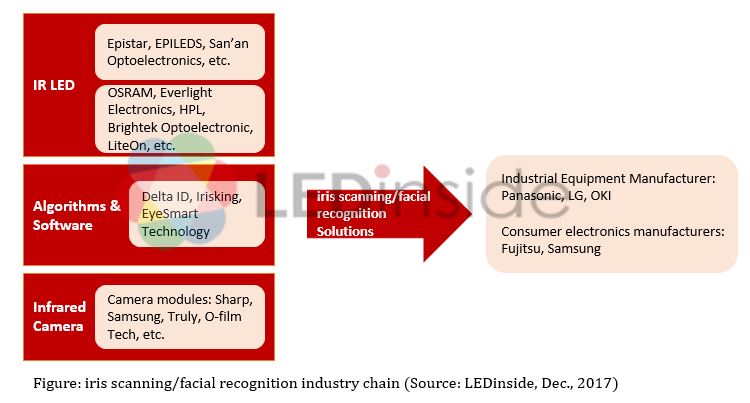
There is also an article on iris scanning "Iris Scanning and Facial Recognition Making Their Way into Consumer Electronics; IR LED Market Becomes the New Blue Ocean:"

Wednesday, January 03, 2018

1st International SPAD Workshop

The 1st International SPAD Sensor Workshop will be held on Feb. 26-28, 2018 in Swiss Alps. The workshop is sponsored by IISS with financial support by SensL, STMicroelectronics, AMS, XFab, TSMC, MPD, Fastree3D, and TowerJazz. The Steering Committee selected over 20 invited speakers from the SPAD community that have been active in one of the big three themes of the workshop: SPAD Technology, Architectures, and Applications.

Online registration will open Wednesday January 10th 2018 at 8:00 am (Swiss time) and will close when maximum attendance is reached.

The Workshop location - village Christophe Racat
SPAD Workshop Agenda

Omnivision Unveils 0.9um Pixel Products

PRNewswire: OmniVision introduced the 1/2.8-inch 24MP OV24A family, built on the PureCel Plus stacked die architecture. These are OmniVision’s first 0.9um pixel sensors for smartphone applications. The PureCel Plus stacked die 0.9um pixel leverages multiple generations of pixel technologies to match the latest 1.0um pixel QE.

The OV24A sensor family consists of three products: the OV24A1Q, OV24A1B and OV24A10. All three versions of the OV24A sensors can support PDAF. The OV24A1Q, with its unique 4-cell color filter pattern, is ideal for front-facing camera applications. This sensor has an on-chip, in-pixel binning feature that captures four times more light photons than a regular 0.9um pixel for better image quality in low-light conditions. Additionally, an application can recover an image to full 24Mp resolution, when paired with OmniVision’s software.

The OV24A1B (monochrome) and OV24A10 (Bayer) are used for main-camera and/or dual-camera configurations, enabling zoom and Bokeh features, and improved low-light performance.

Additionally, increasing image quality for the rear-facing main smartphone camera remains of the utmost importance to most consumers. When it is paired in a dual-camera configuration, the OV24A10 and/or OV24A1B sensors’ 24Mp resolution provides a higher zoom ratio, portrait mode effect, and higher quality still images and video in low light.

The OV24A1Q and OV24A10 provide HDR for still images, as well as HDR video with full resolution at 30fps.

Recent studies have predicted that millennials will take over 25,000 selfies during their lifetime. Image quality is becoming an increasingly important factor in this demographic’s smartphone buying decisions. “Smartphone image quality is essential to many consumers, and social media has particularly inspired millennials to make good use of high-resolution front-facing cameras,” said James Liu, product marketing manager at OmniVision. “Our OV24A image sensor family was developed to address the needs of these savvy consumers, who expect the highest quality stills and videos from their smartphones.”

HiSense and Corephotonics Present Automotive 3D Camera

ElectronicsMaker: Hisense Group and its subsidiary Hisense TransTech and Corephotonics unveil TransportEye stereo camera, said to have the longest detection range currently supported by any automotive stereo camera – reaching distances of up to 100m with a camera baseline of just 12cm.

“This strategic collaboration with Hisense Group is an important milestone for Corephotonics. It extends our reach beyond the mobile sector into exciting new vertical markets, such as automotive,” states David Mendlovic, CEO of Corephotonics. “The combination of our unique innovations in camera design and computational imaging, together with Hisense’s technologies and extensive production capabilities has proven essential for the success of this venture.”


The companies Youtube video demos the camera performance:

Tuesday, January 02, 2018

Shouleh Nikzad Elected to Fellow in the National Academy of Inventors

JPL image sensing leader Shouleh Nikzad has been elected to the rank of Fellow in the National Academy of Inventors (NAI). The NAI Fellows Selection Committee chose her for induction as she “demonstrated a highly prolific spirit of innovation in creating or facilitating outstanding inventions that made a tangible impact on quality of life, economic development, and the welfare of society.”

DSPG, Emza and Himax Announce AI based Human Presence Visual Sensor for Consumer and Industrial Applications

GlobeNewsWire: DSP Group, Emza Visual Sense, and Himax announce the WiseEye IoT, said to be the industry’s first ultra-low power, always-on, intelligent visual sensor adding human presence awareness for consumer appliances and industrial IoT applications.

DSPG’s ULE and SmartVoice solutions, Emza’s machine vision algorithms, and Himax’s low power CMOS Sensor yield a commercially available sensor capable of detecting, localizing, counting and profiling people.

“Machine learning-based sensors enhance the intelligence and functionality of any device, and our trainable WiseEye IoT solution aims at bringing these capabilities to the vast and largely untapped IoT space in both consumer and industrial domains,” said Yoram Zylberberg, CEO of Emza Visual Sense. “In DSP Group, we found a unique combination of offering that fits any IoT supplier – a low power SoC that can serve as a computing platform for our advanced algorithm and ULE modules for easy integration with IoT systems.”

“Himax CMOS Image Sensor, HM01B0, is the first to be specially designed to benefit the computer vision algorithm and we are excited to be a part of this sophisticated new joint offering from Emza and DSP Group,” commented Amit Mittra, CTO of Himax Imaging. “Low power and high performance are critical to the success of this application. Using our CMOS Image Sensor gives WiseEye the ability to bring computer vision to new applications that have been hard to reach before due to cost, performance, and power constraints.”

Monday, January 01, 2018

Velodyne Reduces its Low-End LiDAR Price by 50%

BusinessWire: Velodyne LiDAR announces a cost reduction for its most popular LiDAR sensor. The VLP-16 is now offered to customers around the world for up to a 50% cost reduction.

“Demand for our VLP-16s grew tremendously in 2017. As a result, we increased capacity and now can pass along savings as cost reduction to our customers,” said David Hall, Founder and CEO, Velodyne LiDAR. “We want to make 2018 a year of optimism for the autonomous vehicle, especially as the first waves of robocabs hit the road. Our goal is the democratization of transportation safety by making it accessible to every man, woman, and child in the world as quickly as possible.”