Kuijk et al from Vrije University and Sony Depthsensing Belgium published a paper titled "320 × 240 SPAD Direct Time-of-Flight Image Sensor and Camera Based on In-Pixel Correlation and Switched-Capacitor Averaging" in the special IISW issue of Sensors journal.
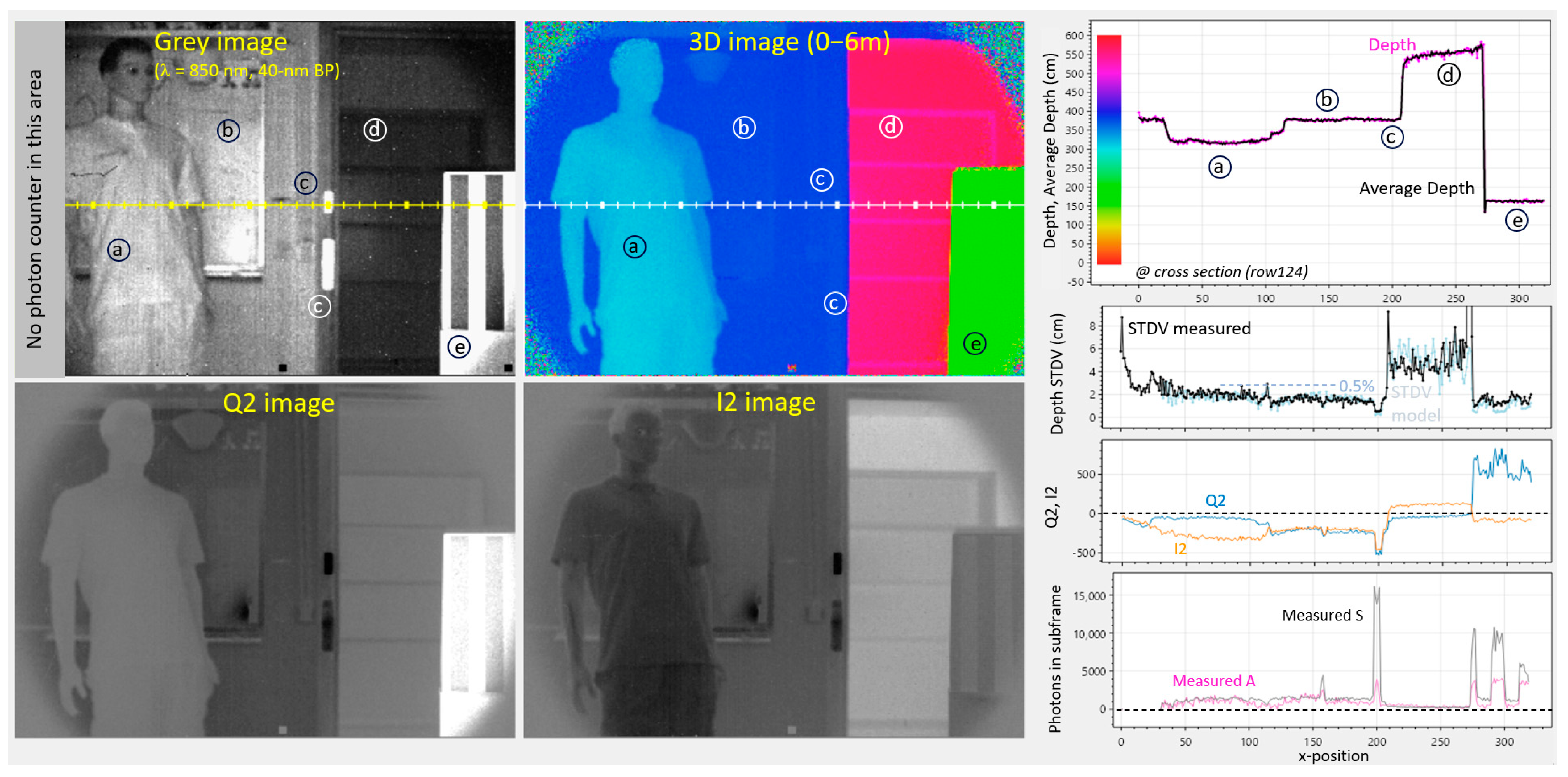
Abstract: Correlation-Assisted Direct Time-of-Flight (CA-dToF) is demonstrated for the first time on a large 320 × 240-pixel SPAD array sensor that includes on-chip high-speed timing support circuitry. SPAD events are processed in-pixel, avoiding data communication over the array and/or storage bottlenecks. This is accomplished by sampling two orthogonal triangle waves that are synchronized with short light pulses illuminating the scene. Using small switched-capacitor circuits, exponential moving averaging (EMA) is applied to the sampled voltages, delivering two analog voltages (VQ2, VI2). These contain the phase delay, or the time of flight between the light pulse and photon’s time of arrival (ToA). Uncorrelated ambient photons and dark counts are averaged out, leaving only their associated shot noise impacting the phase precision. The QVGA camera allows for capturing depth-sense images with sub-cm precision over a 6 m range of detection, even with a small PDE of 0.7% at an 850 nm wavelength.
Open access DOI link: https://doi.org/10.3390/s25216772
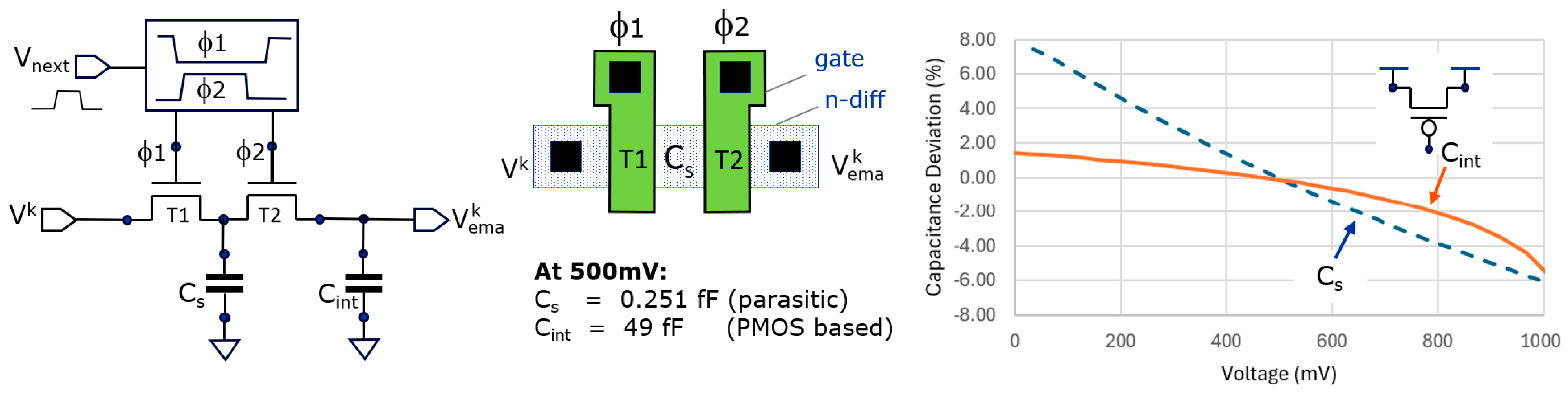
Figure 3. The practical EMA implementation consists of generating non-overlapping clocks (f1 and f2) in response to an edge transition from Vnext, driving the gates of two NMOS transistors (left); the parasitic capacitance of the substrate diffusion diode between the two transistors forms Cs (center); the non-linear behavior of Cs and Cint form spice simulation and are shown on the right.
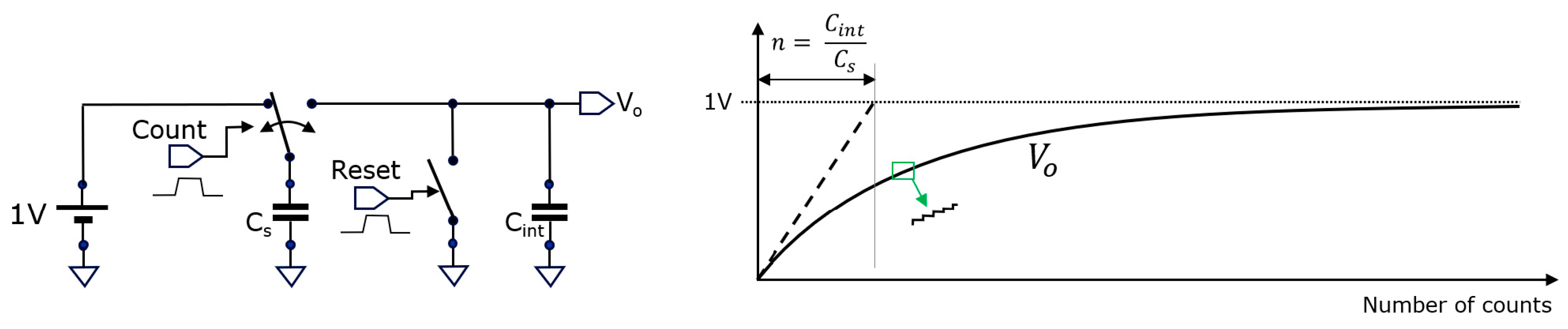
Figure 5. An analog counter based on a switched-capacitor principle, useful for counting events like incident photons. When zooming-in, the step-like behavior becomes visible (in green).
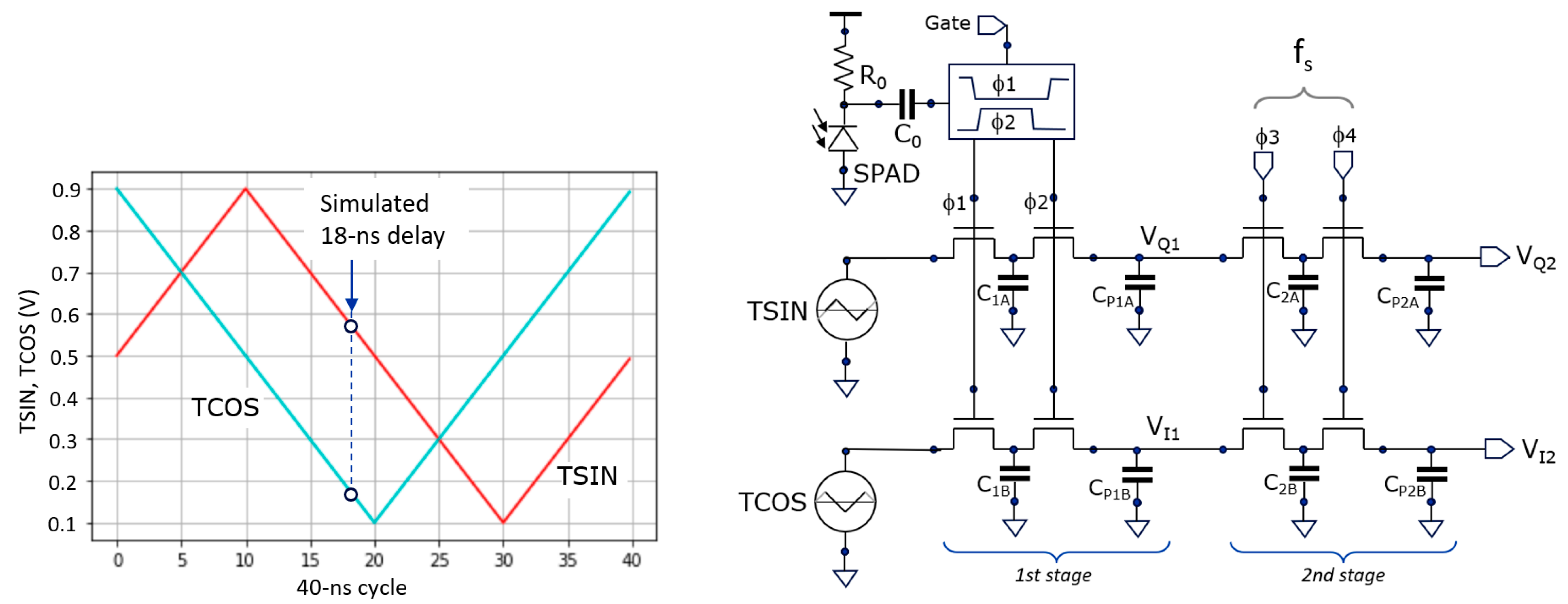
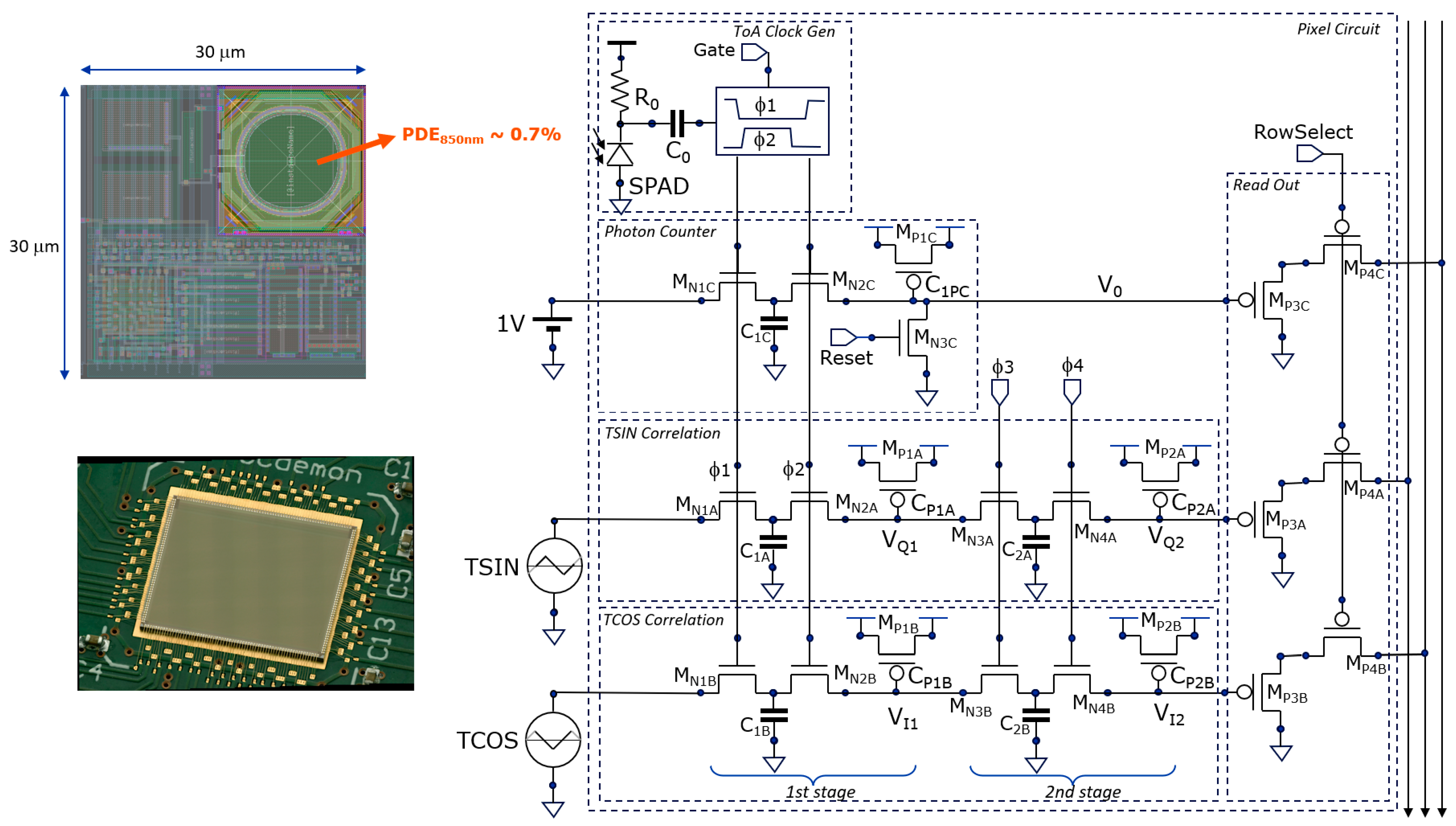
Figure 8. The pixel circuit has a non-overlapping clock generator, a photon counter, and two-stage averaging for the sampled triangular TSIN and TCOS signals.
No comments:
Post a Comment
All comments are moderated to avoid spam and personal attacks.